Mykonos Cottage Style Balcony: Design Ideas & Guide
The whitewashed walls, the pop of loulaki blue, the bougainvillea spilling over a low stone rail. That's the picture most people have in mind when they search for a mykonos cottage style balcony. It looks effortless, but it's actually a highly specific architectural formula repeated across the Cyclades for centuries.
The good news is you don't need to live on a Greek island to pull it off. You just need to understand the proportions, the materials, and the light. Our research into Cycladic building methods shows the look comes down to three rules: chalk-white lime surfaces, a single accent blue, and natural materials that weather gracefully.
Get those right and the rest falls into place.
mykonos cottage style balcony
A mykonos cottage style balcony is a small, cubic outdoor space finished in whitewashed lime plaster, dressed with blue-painted wood accents, and softened with built-in stone benches, clay pots, and a bougainvillea canopy. The style favors handmade texture over polish. It's designed to stay cool under strong Aegean sun and resist salt-laden wind.
What "Mykonos Cottage Style" Actually Means (Before You Buy a Single Blue Pot)
Mykonos cottage style is a regional variant of Cycladic architecture, the vernacular building tradition shared across the Aegean islands. The core idea is simple. Build small, build white, and let the light do the decorating.
Traditional Mykonos homes were designed by farmers and fishermen, not architects. That's why the shapes are so honest. A cube of a house, a flat roof, a low balcony, and a windbreak wall to block the meltemi, the strong summer north wind that sweeps the islands from June through September.
The two things most people get wrong
First, they treat the style as a color scheme. White plus blue equals Greek, right? Not quite.
The aesthetic depends on texture, proportion, and a hint of age. A brand-new, glossy white balcony with a fresh cobalt railing reads as a themed café, not a cottage.
Second, they copy villa-scale features onto tiny spaces. A traditional Mykonos cottage balcony is typically only 3 to 8 square meters. That's small.
Everything in it earns its place.
What made the style practical, not just pretty
Whitewash isn't decorative. Lime reflects solar radiation and helps keep interior temperatures down, which matters when summer highs push past 35°C. The blue shutters and doors were traditionally painted with loulaki, a powdered pigment mixed with water and lime.
It was cheap, widely available, and it matched the sea and sky.
If you're recreating the look, remember this: the style exists because of the climate. Copy the reasoning, not just the colors.
The Visual DNA: 7 Signature Elements You Need to Get Right
Think of these as the ingredients. Miss two or three and the look still works. Miss five and it collapses into generic Mediterranean decor.
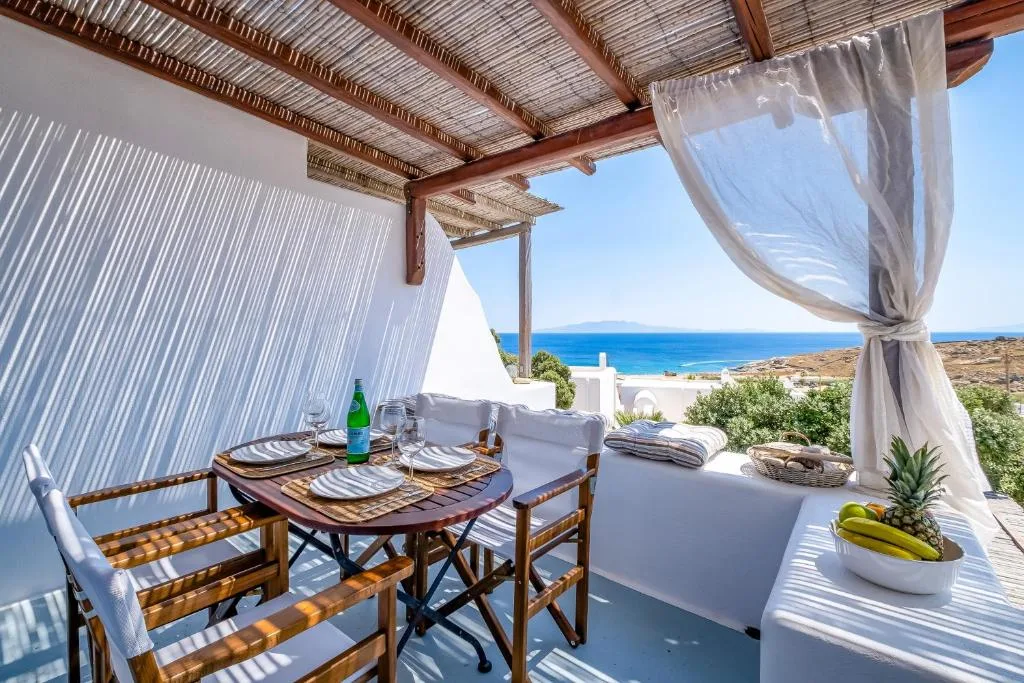
Image source: Bing (Web (fair-use with source credit))
- Cubic, boxy geometry. Flat surfaces, sharp corners, no fussy molding. Even a round pot sits on a square plinth.
- Lime-plastered walls. Chalky, breathable, slightly uneven. Not glossy, not plastic-smooth.
- A single accent blue. Shutters, a door, a railing. Pick one focal point, not five.
- Stone or marble flooring. Honed, matte, cool underfoot. Flagstone in irregular shapes reads more authentic than uniform tiles.
- A wooden pergola or shade sail. Slat spacing controls how much sun reaches the floor below.
- Built-in or heavy seating. A stone bench or a substantial wooden piece. Flimsy flat-pack chairs fight the look.
- One hero plant. Bougainvillea, an olive sapling, or rosemary in a large terracotta pot.
The "less is more" test
Stand back and squint. If your balcony has more than four visual elements competing for attention, remove one. Traditional Cycladic homes are nearly empty.
A bench, a table, a plant, and the view.
Materials That Make or Break the Look — Limewash, Stone, Wood, and Loulaki Blue
This is where most DIY recreations fall apart. The right materials cost a bit more, but they age in the right direction. Cheap substitutes look wrong within a season.
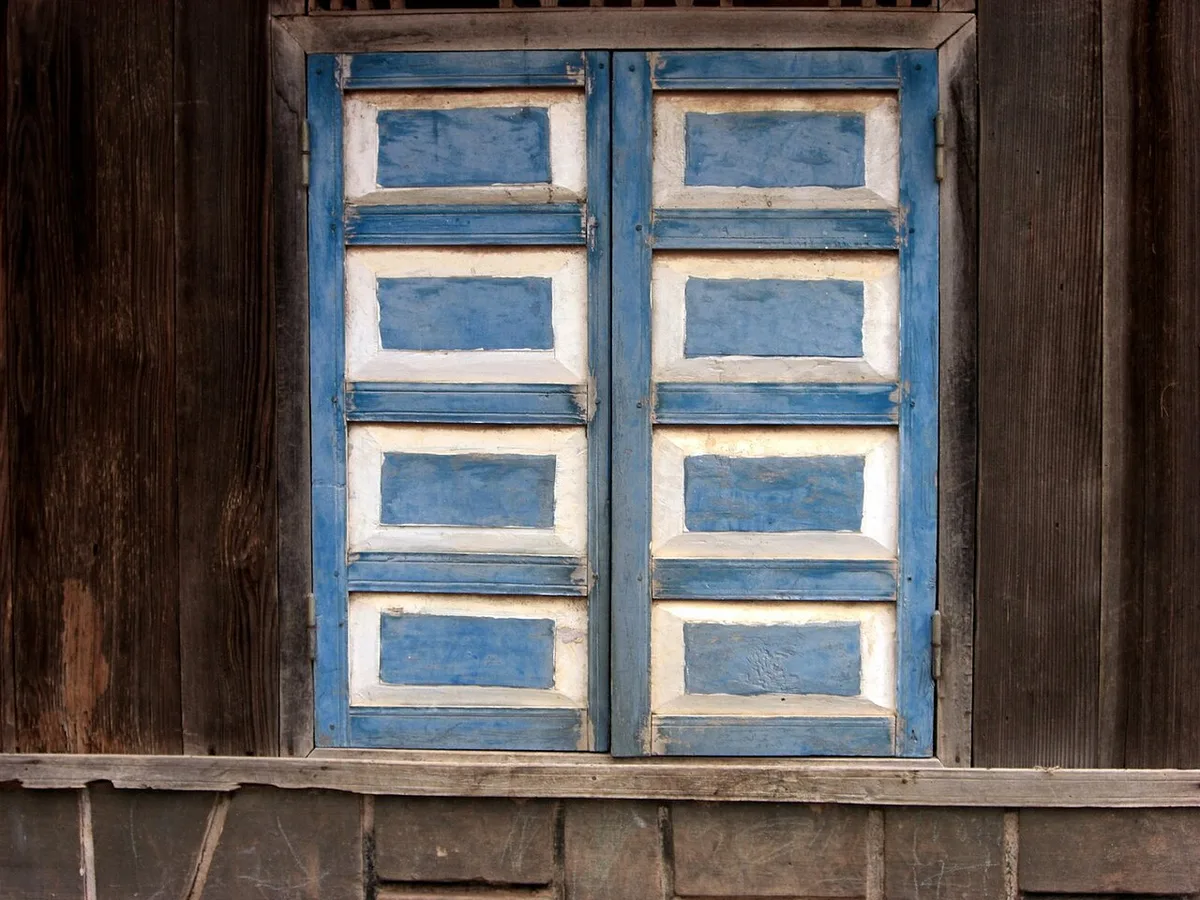
Image source: Wikimedia Commons / Dinkum
Wall finish: limewash vs mineral paint vs acrylic
Limewash is the historical choice, made from slaked lime and water. It breathes, it cures to a soft matte, and it develops a gentle patina over time. Mineral (silicate) paint is a close modern cousin with better durability.
Standard acrylic exterior paint is the cheapest option but looks flat and plastic on stucco.
Manufacturer data sheets for lime-based coatings typically list coverage around 8 to 12 m² per litre, applied in multiple thin coats. Cure time between coats runs 24 to 72 hours. Full carbonation, the chemical reaction that hardens lime back into limestone, takes several weeks.
Blue: real loulaki vs modern paint
Traditional loulaki pigment came as a powder you mixed with lime. Modern equivalents are pre-mixed exterior paints in shades that range from sky blue to deep cobalt. Aggregate reviews of exterior coatings in high-UV regions suggest repainting blue accent surfaces every one to three years to keep the color from fading.
Wood and stone
For pergolas, look at eucalyptus, chestnut, or treated pine. These hold up in coastal air. Offshore installations should use 316 marine-grade stainless fixings rather than 304, which corrodes faster in salt spray.
For flooring, honed limestone, marble, or matte porcelain that mimics stone all work. Skip polished tiles. They look wrong here and get dangerously slick when wet.
| Surface | Best Pick | Watch Out For |
|---|---|---|
| Walls | Limewash or mineral paint | Acrylic looks plasticky on stucco |
| Shutters | Exterior paint in loulaki tones | Fades fast in high UV |
| Flooring | Honed limestone or matte porcelain | Polished tiles get slick |
| Pergola wood | Eucalyptus, chestnut, treated pine | Untreated softwood warps |
| Fixings | 316 marine-grade stainless | 304 corrodes in salt air |
How to Recreate It Step by Step: From Bare Balcony to Cycladic Corner
This is a weekend project for most balconies, spread over two to three weeks when you account for drying time. Work in this order and you'll avoid redoing anything.
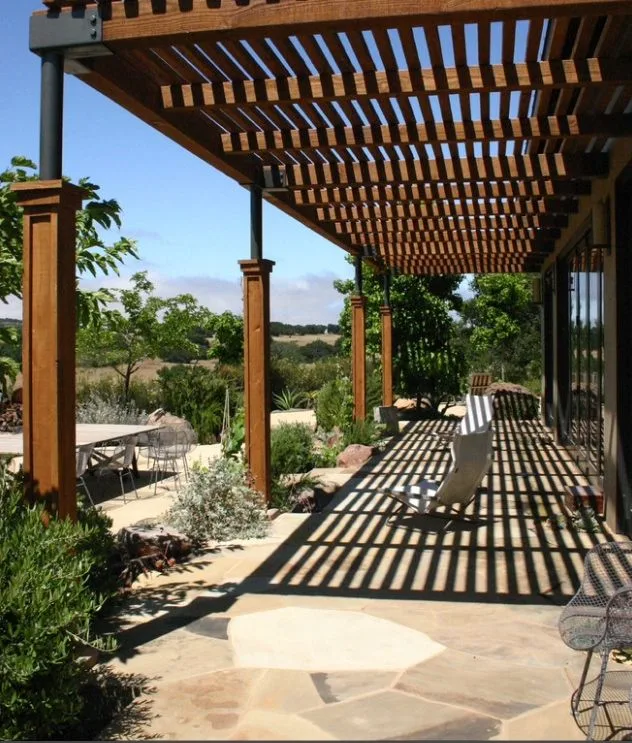
Image source: Bing (Web (fair-use with source credit))
Step 1: Assess the space
Check sun direction, wind exposure, and load limits. Balconies have weight restrictions, and large planters plus a stone bench add up fast. Check your building's rules before you build anything structural.
Step 2: Prep and finish the walls
Clean the surface, fill cracks, and prime bare stucco. Apply limewash or mineral paint in thin, overlapping coats. Let each coat cure 24 to 72 hours.
Don't rush this stage. Thick single coats crack.
Step 3: Install shade
Fit a wooden pergola or tensioned shade sail. Slat spacing of 5 to 10 cm gives you roughly 40 to 80% shade, enough to make the space usable in midsummer.
Step 4: Floor and furniture
Lay or seal the floor. Then bring in the built-in bench or your main seating piece. Add one small table.
That's it for furniture.
Step 5: Paint the accent blue
Choose one element: shutters, a door frame, a railing, or a single planter. Paint it in a loulaki-inspired blue. Let it be the only bright thing on the balcony.
Step 6: Plant and light
Set a large terracotta pot with bougainvillea, olive, or rosemary. Add warm, low lighting in lanterns or hanging fixtures. Avoid cool white LEDs.
They kill the mood instantly.
Step 7: Style, then subtract
Place a few textured accessories. Then remove one item. Traditional Cycladic balconies are almost bare, and yours should feel that way too.
Adapting Mykonos Style to Your Climate, Space, and Building Rules
The look travels, but it needs translation. A Cycladic balcony works in Mykonos because of the specific mix of sun, salt, and wind. Your space has its own conditions.
If you live in a cold or humid climate
Pure chalk white can look gray and gloomy under northern European or Pacific Northwest skies. Shift toward a warm off-white and add more wood to compensate. Limewash also chalks in freezing conditions, so mineral paint may hold up better.
If your balcony is tiny
Lean on verticals. Use a wall-mounted fold-down table, hanging planters, and a built-in bench that doubles as storage. Skip the pergola if ceiling height is low.
A tensioned shade sail saves space and reads well.
If you're in an apartment with HOA rules
Check before you paint anything. Many buildings restrict exterior color changes, structural additions, and hanging planters over railings. Confirm what's allowed, then adapt within those limits.
If you're creating a vacation rental
Guests respond to photogenic, uncluttered spaces. Emphasize the hero plant, the light, and the view. Staging this look consistently is one reason boutique rentals in the Mediterranean command higher nightly rates, and it works the same way anywhere the balcony has a view worth selling.
If you're in a hot, dry climate like California or southern Australia
You're in the easiest position. The Mykonos formula transfers almost directly. Watch water use, though.
Bougainvillea is drought-tolerant once established, but it needs deep watering in its first two seasons. Rosemary and olive handle dry heat better than most flowering vines.
Where It Usually Goes Wrong: Common Styling Mistakes and Fixes
Most failed Mykonos recreations fail for the same handful of reasons. Here's what to watch for, and how to fix each one.
- Overusing blue. The style has one accent color, not five. If your shutters, railing, pots, and cushions are all blue, you've built a theme, not a balcony. Fix: pick one blue element and repaint the rest in white or natural tones.
- Going too glossy. High-sheen paint, polished tiles, and chrome fittings all fight the handmade look. Fix: switch to matte or chalky finishes and matte metals, or skip metal entirely in favor of wood and clay.
- Skipping the texture. Flat, factory-smooth surfaces read as modern apartment, not island cottage. Fix: use limewash, stucco, or a deliberately uneven surface somewhere visible.
- Buying cheap lightweight furniture. Plastic bistro sets and thin aluminum chairs blow over in wind and look wrong. Fix: go heavier, not lighter. Wood, stone, or substantial metal frames.
- Cluttering with props. Blue-and-white striped cushions, "authentic" Greek signs, fishing nets, and driftwood all read as costume. Fix: remove anything that isn't functional or a plant.
- Ignoring shade. A white balcony with no cover is unusable at midday in summer. Fix: pergola, sail, or a large umbrella with a natural canvas in a neutral tone.
- Treating plants as decor. Bougainvillea needs pruning, feeding, and space. A sad, leggy plant ruins the look faster than a bad paint color.
The wind problem nobody warns you about
The meltemi is the reason traditional Mykonos balconies have low solid walls and heavy benches. If your space is exposed to strong wind, weight matters. Lightweight pots tip.
Shade sails tear if they're badly anchored. Fixings pull out of old masonry. Anchor everything properly or accept that summer storms will rearrange your balcony for you.
Costs, Maintenance, and What to Expect Over Time
Budgets vary wildly here, so let's talk ranges rather than fixed numbers. As of 2026, a small DIY refresh (paint, one pot, one plant, a few accessories) can be done for a few hundred dollars. A full build with a timber pergola, stone floor, and built-in bench pushes into the low thousands.
What you'll spend time on, not money
The real cost of this style is maintenance. Lime and mineral finishes need touch-ups. Blue accents fade and need repainting every one to three years in high-UV regions.
Wood needs oiling or sealing annually. Bougainvillea needs pruning at least twice a year and often more.
A simple maintenance calendar
- Spring: Check fixings, oil wooden furniture, repaint any faded blue, prune bougainvillea hard.
- Summer: Water deeply, especially new plants. Check shade fabric for tears.
- Autumn: Clean stone floors, bring cushions and textiles indoors, seal any cracks in lime finish.
- Winter: Inspect for corrosion on fixings and metal furniture. Cover or store light items.
When to bring in a professional
If your balcony needs structural work, pergola anchoring into load-bearing walls, or drainage correction, call someone qualified. Balcony load limits and railing heights are covered by building codes in most countries, and getting it wrong isn't just ugly. It's dangerous.
Local building regulations in the South Aegean region also restrict exterior changes on protected Cycladic properties, so check before you modify anything if you own one.
FAQs: Wind, Plants, Paint, and Small-Space Realities
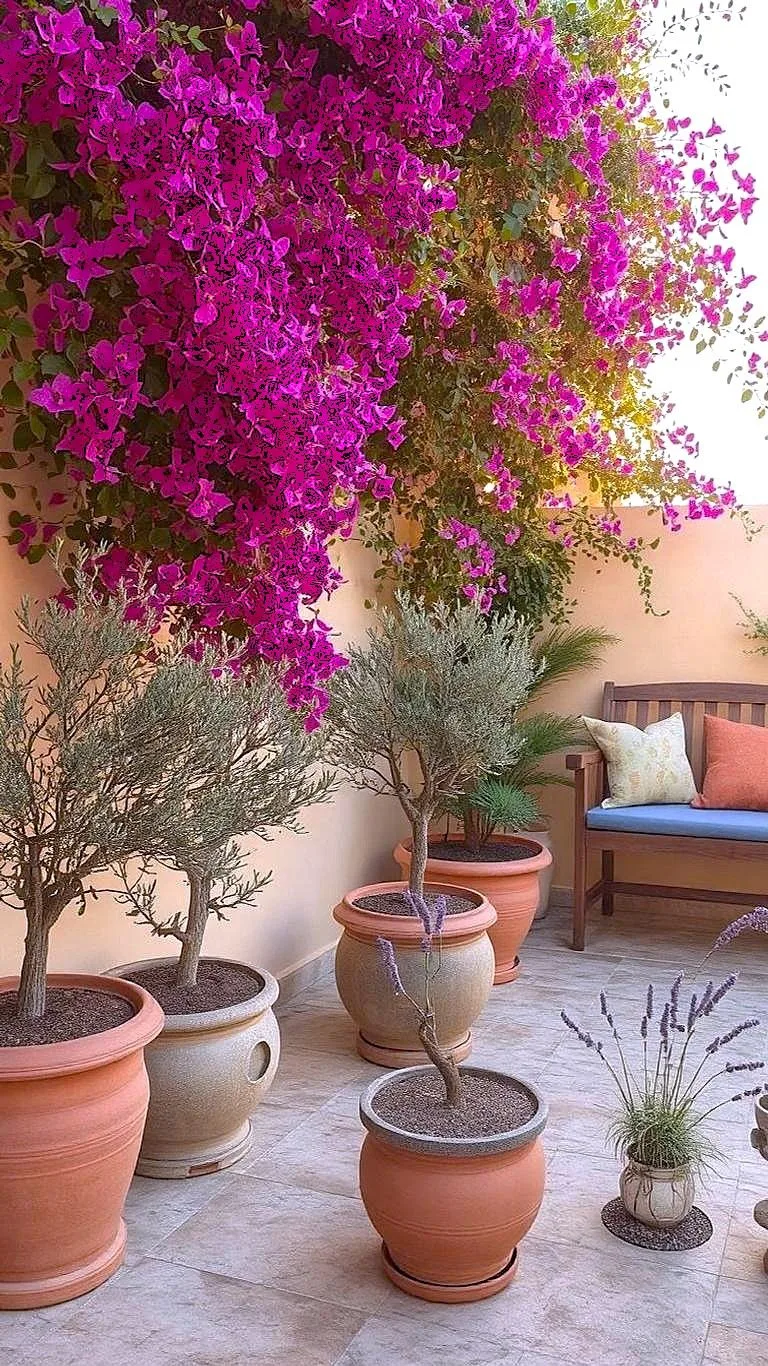
Image source: Bing (Web (fair-use with source credit))
Can I recreate this look on a small apartment balcony?
Yes. Focus on three elements only: a whitewashed or off-white backdrop, one blue accent, and one large plant in a terracotta pot. Skip the pergola if space is tight and use a tensioned sail instead.
Small spaces reward restraint more than large ones do.
What plant best captures the Mykonos look?
Bougainvillea is the classic choice, but it's thorns, aggressive growth, and constant leaf drop make it high-maintenance. Rosemary, olive, and oleander are easier alternatives that still read as Mediterranean. In cooler climates, choose a compact olive variety in a large pot.
Does the white paint have to be limewash?
No, but limewash and mineral paint give the authentic chalky finish. Standard acrylic paint works and lasts longer in harsh weather, but it looks flatter and more modern. If your balcony is exposed to heavy rain or frost, mineral paint is usually the better trade-off.
How do I stop blue paint from fading?
Use an exterior-grade paint rated for UV exposure, and consider a marine-quality coating if you're near saltwater. Expect to touch up every one to three years in strong sun. Lighter blues fade less noticeably than deep cobalts, so pick a mid-tone if you want to stretch the interval.
Is a pergola worth it on a windy balcony?
Only if it's properly anchored. A poorly fixed pergola in high wind is a safety risk, not a design feature. If wind is a real problem, use a low windbreak wall or a shade sail with reinforced anchor points instead.
Traditional Mykonos builders chose low solid walls for exactly this reason.
What's the biggest styling mistake people make?
Adding too much. The style's power comes from restraint: chalk-white surfaces, one accent color, natural texture, and space to breathe. If your balcony feels busy, you've added one thing too many.
Take something away and the look improves.
Real Scenarios: Three Balconies, Three Different Approaches
Picture three balconies. Each one wants the Mykonos look, and each one needs a different plan.
The first is a 4 m² apartment balcony in Lisbon, south-facing but sheltered. Here the conditions are close to ideal. A lime-washed wall, one blue-painted railing, honed limestone tiles, and a single olive tree in a terracotta pot.
Total cost stays low, and the plant survives the dry summer without much fuss.
The second is a rooftop terrace in Chicago, exposed to wind and hard frosts. This one needs adaptation. The white shifts to warm off-white, and the pergola wood is heavy treated timber with fully bolted anchors.
Bougainvillea won't survive the winter, so a dwarf olive in a frost-protected pot replaces it indoors from November to March.
The third is a Greek island rental in Paros, salt-soaked and wind-battered. Everything here is marine-grade: 316 stainless fixings, low solid windbreak walls instead of tall railings, and heavy stone benches that don't move in the meltemi. This is the version closest to the original, because the climate forces you to build it right.
What the three cases teach
Climate drives the material list more than aesthetics do. If your conditions differ from the Aegean, your palette changes, but the principle stays the same. Chalky white, one accent blue, natural texture, and weight.
That's the whole formula.
A Quick Decision Guide: Which Version Is Right for You
Start with your climate, then work down.
- Hot, dry, coastal (California, Greece, southern Australia): Use the full traditional formula. Limewash walls, stone floor, wooden pergola, bougainvillea if you have space.
- Hot but humid (Florida, Southeast Asia): Swap limewash for mineral paint, and choose mildew-resistant finishes. Pick plumeria or frangipani over bougainvillea if you want flowers.
- Cold or temperate (UK, Northern Europe, northern US): Warm off-white, mineral paint, more wood to add warmth. Choose a compact olive or rosemary, and move tender plants indoors for winter.
- Windy exposure: Add weight. Heavy benches, low windbreak wall, bolted pergola, and no lightweight bistro sets.
- Tiny urban balcony: Go vertical. Fold-down table, wall planters, one big statement pot. Skip the pergola entirely and use a tensioned sail.
If you're short on time
Choose the simplest version that still reads as Mykonos. Repaint the wall a chalky white, add one blue element, drop in a large terracotta pot with an olive, and stop. That's it.
Everything else is optional.
If you're building long-term
Invest in the structure first: floor, drainage, fixings, and shade. These are the parts that fail first, and they're the hardest to change later. Surface styling is easy to add or swap.
Get the bones right and the style will hold up for a decade or more.
Frequently Asked Questions
Do I need to live in Greece to pull off this look?
No. The look depends on materials and restraint, not location. A chalky white wall, one blue accent, natural texture, and a single large plant read as Mykonos anywhere.
Adapt the plant and paint to your local climate, and keep the palette consistent.
What's the cheapest way to start?
Paint one wall in matte off-white and buy a single large terracotta pot with a rosemary plant. That's the whole entry point. Add the blue accent next, then the flooring.
Staging the look gradually lets you see what actually works in your space before spending more.
Can I fake the look with peel-and-stick or printed panels?
You can, and in a rented apartment it's sometimes the only option. Faux limewash wallpaper, stick-on stone-effect floor tiles, and faux bougainvillea panels all exist. The trade-off is that they look convincing at a distance but cheap up close, and they don't age well in sun or salt air.
How much shade do I actually need?
Enough to make the balcony usable in early afternoon. A pergola with slats spaced 5 to 10 cm apart typically cuts 40 to 80% of direct sun. If midday heat is intense, aim for the higher end of that range.
More shade also means more watering, since plants below get less rain.
What's the number one thing that ruins the look?
Too much decoration. The style has one strong note: chalky white. Every added blue pot, striped cushion, or coastal ornament dilutes that note.
Remove items until the space feels slightly empty, then stop. That's the correct amount.
Do I need to worry about balcony load limits?
Yes. Stone floors, large planters, built-in benches, and pergolas add real weight. Most residential balconies are rated for a fraction of what people assume, and the limit is usually stated in kilograms per square metre in the building documentation.
If you're planning anything structural, check before you build.

Similar Posts