Record Player Corner: Setup, Placement & Buying Guide
Corner placement looks like the obvious win when you're short on floor space. It hides cables, gets the turntable out of the walkway, and turns a dead zone into a listening ritual. But a corner is also where sound waves pile up, floors transmit the most vibration, and heat and dust collect in ways that quietly degrade vinyl playback.
In our research across manufacturer manuals and acoustics literature, we found that corner loading (the way low frequencies build up where two walls and the floor meet) can boost bass output by 3 to 6 dB near the corner itself. The RIAA equalization curve assumes a flat, neutral playback path, so that boost isn't free. It's what makes one corner setup sing and the next one boom.
Here's how the geometry actually works.
record player corner
A record player corner is a high-fidelity setup where the turntable, amplifier, and speakers are arranged in the corner of a room. The main goal is to isolate the turntable from vibration. Speakers must sit well away from the corner walls.
Done right, a corner rig saves space and protects the tonearm.
Why a Corner Is Both the Best and Worst Spot for a Turntable
A corner gives you two walls for free. You can stack records vertically, run cables along the baseboard, and keep the whole rig out of the room's traffic lane. For renters in small apartments, that's often the only realistic listening zone.
Then the physics kicks in. Corners are pressure zones. Bass wavelengths are long enough that they bounce off both walls and reinforce each other, which is why corner-placed speakers always sound bassier than the same speaker at mid-wall.
For a turntable, the bigger risk is vibration. A belt-drive deck plays at 33⅓ RPM, and the stylus tracks a groove only a few microns wide. Footfalls, walking basslines, and speaker cabinet resonance all feed back into the platter.
Wooden joist floors make this worse. So the corner is either your savior or your sabotage, depending on how you treat the three variables below.
- Speaker distance from the corner: minimum 12 to 18 inches from both walls.
- Turntable isolation: spring feet, sorbothane pucks, or a wall-mounted shelf.
- Vertical separation: speakers not on the same surface as the turntable.
The Corner Setup at a Glance: What Actually Goes Where
Here's the honest version of what a working corner rig looks like. Diagrams help here, because the spatial relationship is what makes or breaks the sound. Picture the turntable on its own stable shelf, the amp on a separate level, and the speakers pulled forward and toed in.
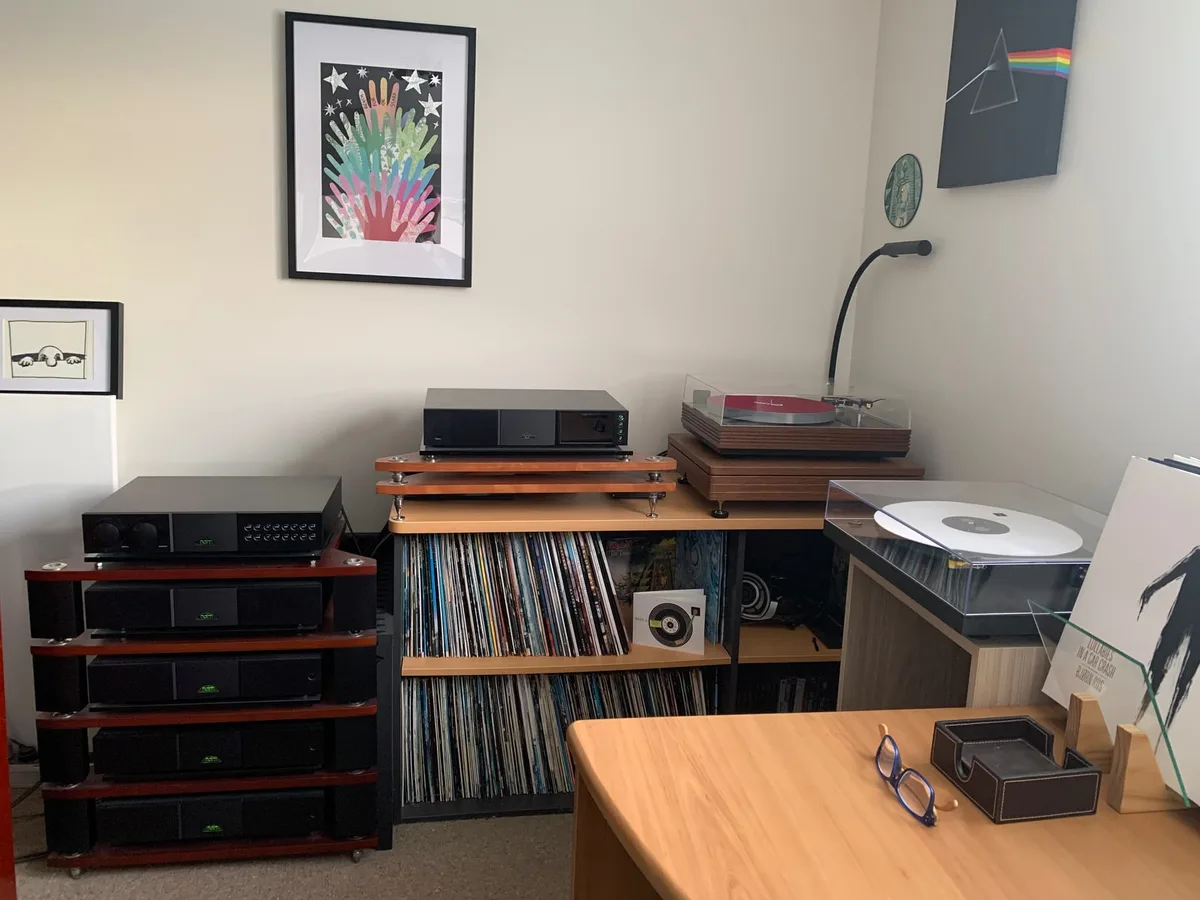
Image source: Bing (Web (fair-use with source credit))
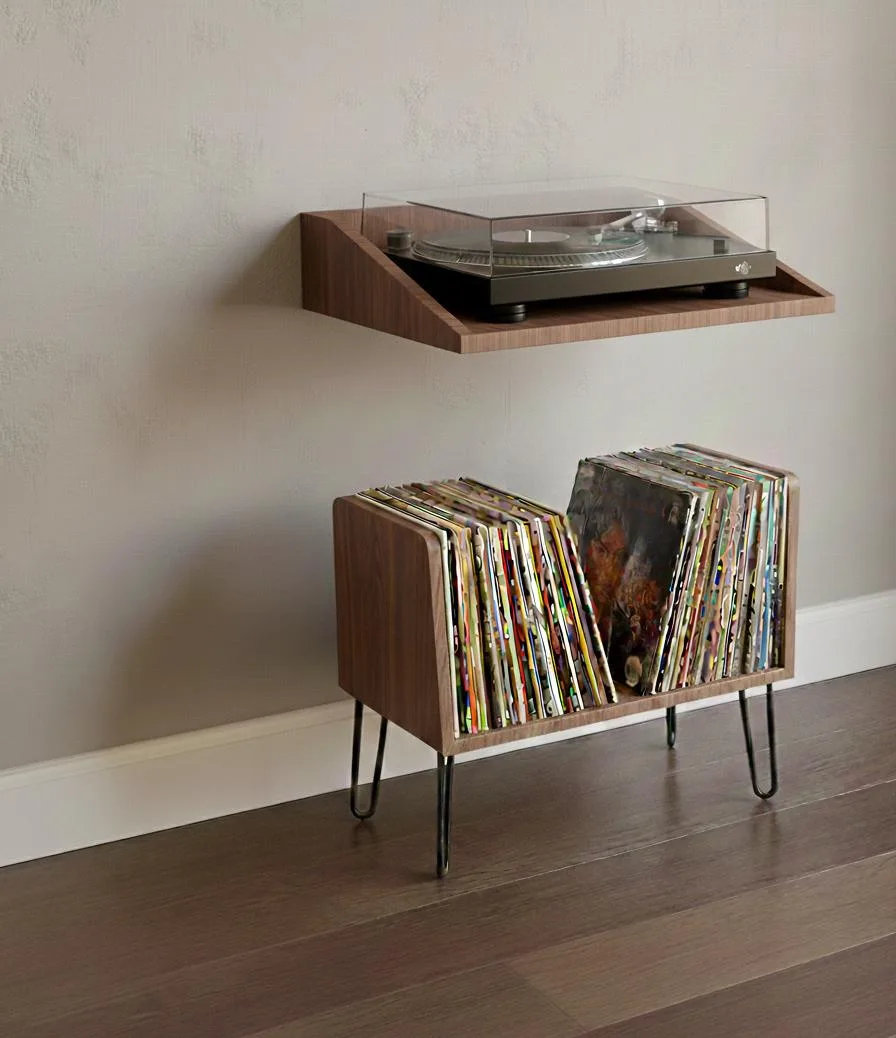
Image source: Bing (Web (fair-use with source credit))
| Component | Where It Goes | Why It Matters |
|---|---|---|
| Turntable | Dedicated level shelf, minimum 6" clearance each side | Needs to be level, stable, and away from speaker vibration |
| Amplifier | Separate shelf with airflow | Heat buildup in enclosed cabinets degrades components |
| Passive speakers | 12 to 18" off both walls, toed in | Reduces corner bass buildup, sharpens imaging |
| Record storage | Vertical shelf, floor to shoulder height | Keeps LPs flat, adds mass to dampen the room |
| Cable run | Along baseboard, bundled with ties | Reduces clutter and prevents accidental tugs |
A note that surprises first-timers. Placing the turntable on top of the same cabinet as the speakers is the single most common corner mistake. Even at moderate volume, the cabinet acts like a drum, and the stylus picks up every thump.
If you have no wall-mount option, put the turntable on a separate piece of furniture from the speakers. A cheap IKEA Kallax with the turntable on top and the records filling the cubes below works surprisingly well. The mass of 50 to 80 LPs dampens the shelf's resonance.
The Spatial Rules That Make or Break a Corner Rig
Treat these as the working rules. They come from room acoustics basics, and every one of them can be bent but not broken.
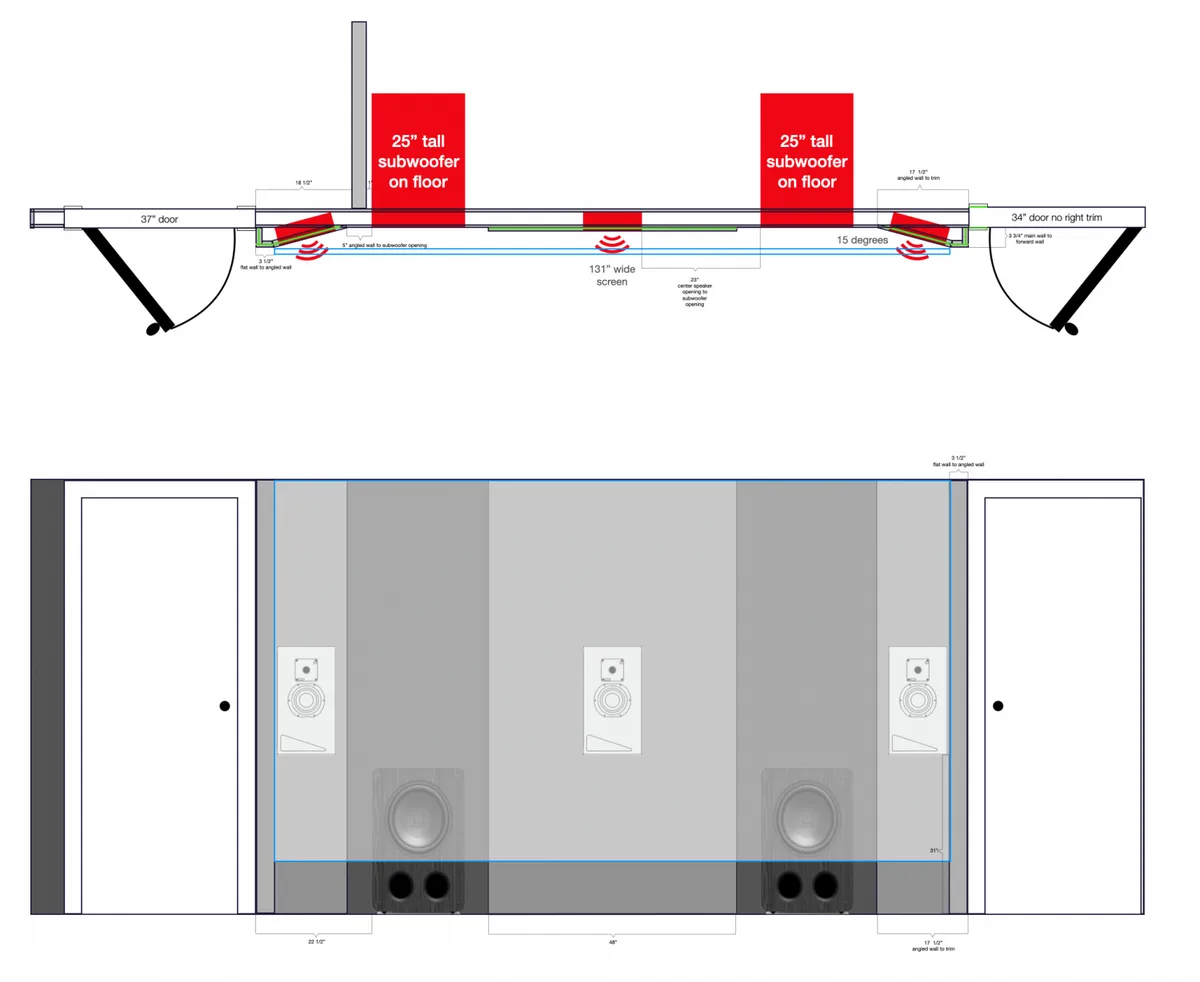
Image source: Bing (Web (fair-use with source credit))
- Distance from the corner: pull the speakers out at least 12 to 18 inches from each wall. Closer than that and the bass boost starts dominating the mids.
- Triangle geometry: the two speakers and your listening seat should form a triangle roughly 6 to 8 feet on each side. Toe the speakers in toward your head.
- Vertical alignment: tweeters at ear height when seated. If your speakers sit low, a 6 to 8 inch angled foam pad fixes it.
- Turntable level: use a bubble level on the platter. Even a 1-degree tilt will pull the tonearm inward on every rotation.
- Ground separation: the turntable should sit on a different surface from the speakers, period.
- Symmetry: if the corner has one open side and one wall side, expect asymmetric imaging. Add absorption on the wall side with a thick curtain or foam panel.
- Outlet planning: corners are often the worst place for power. A single 15A outlet running a turntable, amp, and speakers is fine. Do not daisy-chain power strips; per US CPSC guidance, overloaded outlets are a leading cause of household electrical fires.
Between 100 and 400 Hz, corner placement creates standing waves you can hear as a muddy, one-note bass. That's one reason audiophiles fight the corner rather than embrace it.
Step-by-Step: Building Your Record Player Corner
Work through this in order. Skipping the leveling step or the ground wire produces hum you can't diagnose later.
- Pick the corner carefully. Choose one with a solid floor, away from heating vents and direct sunlight. Windows warp records.
- Measure your footprint. A typical turntable is about 14 by 14 inches. Add 6 inches clearance on each side and 10 inches above for the dust cover to open.
- Set up the shelf or rack. Wall-mounted shelves isolate best. If you're renting and can't drill, a heavy floor unit is the fallback.
- Level the turntable. Adjust the feet until the bubble is centered. Re-check after 24 hours, because wood floors settle.
- Assemble the tonearm. Follow the manual for balancing and setting tracking force. Most cartridges run 1.5 to 3.0 grams.
- Set anti-skate. Match the tracking force value on the dial. Too much pulls sideways. Too little lets the arm drift.
- Connect the signal chain. Turntable → phono stage → amp → speakers. If your amp has no phono input, you need a separate phono preamp.
- Attach the ground wire. The thin spade connector goes to the amp's ground screw. Without it, you get a low buzzing hum that gets louder with volume.
- Position the speakers. Pull them out from the walls, toe them in, and aim the tweeters at your seated ear height.
- Add isolation under the turntable. Sorbothane pucks, a cork plinth, or spring feet all work. Test by tapping the shelf while a record plays.
- Route the cables. Bundle with velcro ties, keep power cables away from signal cables, and leave slack at the tonearm end.
- Clean the record before first play. Carbon fiber brush plus a wet clean for older vinyl. Dust is the number one cause of ticks and pops.
- Calibrate speed. Use a strobe disc or a phone app. Ideal wow and flutter is under 0.15% for belt-drive and under 0.05% for a good direct-drive deck.
- Do a listening test. Play a familiar record at moderate volume. If you hear rumble, move the speakers farther apart. If you hear hum, recheck the ground.
Total setup time runs 60 to 90 minutes for a first-timer. Re-checking level and tracking force after a week is worth the five minutes.
The Three Classic Corner Problems (And How to Fix Each One)
Every corner rig runs into the same three issues. Knowing them upfront saves weeks of trial and error.
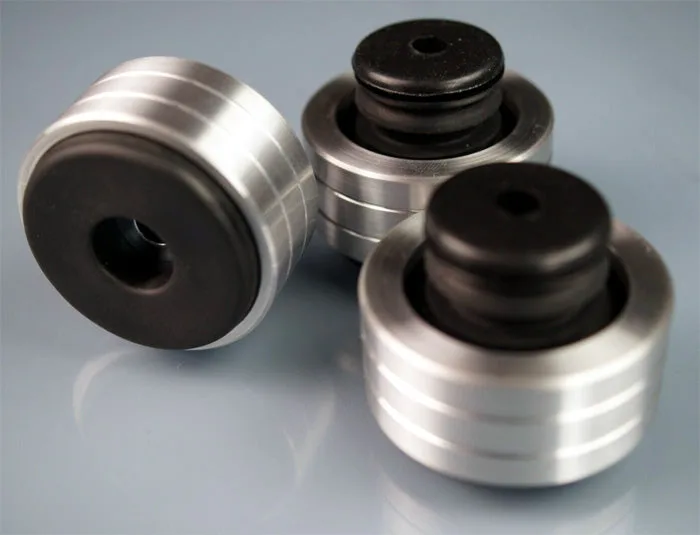
Image source: Bing (Web (fair-use with source credit))
Why does my corner setup sound boomy?
Boomy sound comes from corner loading. Two walls reflect bass energy back into the room, and the frequencies around 100 to 300 Hz build up before your ears hear them. Fix it by pulling the speakers 12 to 18 inches off both walls.
Add a bass trap (a simple corner foam wedge or a rolled-up duvet in a covered frame) behind the speakers. If your speakers have a rear port, keep at least 18 inches between the port and the wall.
Why does my stylus skip when I walk past?
This is footfall vibration. Wooden floors flex under weight, and that flex travels through the furniture into the platter. First test: put the turntable on a wall-mounted shelf that doesn't touch the floor.
Second option: sorbothane pucks under the turntable feet. Third: a thicker platter mat, cork or rubber, which dampens high-frequency resonance. If you live in an upstairs flat, a wall shelf is basically mandatory.
Why is there a buzzing hum that gets louder with volume?
That's a ground loop. The tonearm cable has a thin ground wire that must screw into the amplifier's ground terminal. If your amp has no ground screw, some phono preamps include one.
Check that the wire isn't loose, isn't touching a signal cable, and isn't coiled near a power supply. If the hum persists, try a different outlet for the amp than for the turntable, since shared circuits can introduce noise.
Gear, Costs, and What You Actually Need to Spend
You don't need audiophile money to build a corner rig that sounds good. Entry-level belt-drive decks from Audio-Technica, Fluance, and U-Turn start around $150 to $300. Those come with a built-in phono stage or a cartridge you can upgrade later.
A decent pair of powered bookshelf speakers adds another $200 to $400.
Here's how the tiers shake out as of 2026.
| Tier | Total Budget | What You Get |
|---|---|---|
| Starter | $300 to $500 | Entry belt-drive, powered speakers, no external phono stage |
| Mid-fi | $700 to $1,500 | Better cartridge, passive speakers, dedicated phono preamp |
| Audiophile corner | $2,000+ | Direct-drive or high-end belt, well-matched amp and speakers, room treatment |
The single biggest sound upgrade under $100 is a cartridge swap. A $50 to $100 moving magnet cartridge like an Audio-Technica AT-VM95E transforms a cheap deck. Next in line is isolation, which costs almost nothing.
Sorbothane pucks run $15 to $30 for a set of four.
Skip the $5 slipmat upgrades. Cork and rubber mats (typically $20 to $50) genuinely reduce static and improve clarity. Felt mats actually attract dust and contribute to static buildup.
Record storage is the hidden cost. A Kallax 2×4 unit holds around 300 LPs and runs about $90. A proper record crate handles 50 to 80.
Budget 80 to 100 LPs per shelf cube, and remember that vinyl weighs about a pound per LP.
Common Mistakes That Wreck Corner Sound
Putting the turntable and speakers on the same surface is the number one mistake. It creates a feedback loop: speaker vibration travels through the cabinet into the platter, and the stylus reads that vibration as noise. Even a cheap plastic deck on top of a bookshelf speaker will skip at moderate volume.
Other frequent errors:
- Ignoring the ground wire. Without it, you get a hum that's often mistaken for a bad cartridge.
- Setting tracking force by feel. Use a digital stylus gauge ($15 to $25). Too light causes skipping, too heavy wears records.
- Skipping anti-skate. It must be set. Otherwise the stylus pushes against one groove wall and wears it faster than the other.
- Sunlight placement. UV light warps vinyl and yellows dust covers. Never put a corner rig next to a window.
- Firing speakers into the corner. Speakers aimed at a corner reflect sound back at you out of phase. Toe them toward your listening seat instead.
- Storing records horizontally. Always store LPs vertically. Stacked records warp under their own weight.
- No cleaning routine. A carbon fiber brush before every play is 10 seconds and extends stylus life by hundreds of hours.
Speaking of stylus life, a diamond tip lasts roughly 500 to 1,000 hours. That's a few years of regular play. Replace it once you hear distortion on inner grooves, not before.
Corner Setup FAQs
The questions below come up constantly in vinyl forums and manufacturer support pages. Each answer assumes a typical home setup with a belt-drive deck and bookshelf speakers.
Can I put a turntable directly in a corner?
Yes, but keep speakers off the same surface and pull them 12 to 18 inches off both walls. The turntable itself can sit in the corner. Just make sure the surface is level and isolated from the floor.
Do I need a phono preamp for a corner setup?
Only if your amplifier or powered speakers lack a phono input. Many affordable turntables have a built-in phono stage. Check your manual.
If you see a switch labeled "line" and "phono," you're covered.
How far should speakers be from the corner walls?
Aim for 12 to 18 inches minimum from both walls. More distance reduces bass buildup. In small rooms, 18 inches is often the sweet spot before imaging starts to collapse.
What's the cheapest way to reduce vibration?
Sorbothane pucks or a cork plinth under the turntable feet. A wall-mounted shelf is even better if your lease allows drilling. Total cost for the puck option is under $30.
Can I put the turntable on a record shelf?
Yes, and it works well. A sturdy shelf filled with records adds mass, which dampens resonance. Just keep the speakers off the same unit and make sure the shelf is level.
How often should I recalibrate tracking force?
Check it every 3 to 6 months, or whenever you change cartridges. Tracking force drifts as the tonearm springs age. A quick gauge check takes under a minute and protects your records.

Similar Posts