Small Landing with Bench Storage: Space-Saving Ideas
Most people picture a bench, measure the landing, and then discover the numbers don't work. A small landing with bench storage isn't a furniture problem first. It's a measurement and clearance problem.
Get the layout right and almost any style of bench will fit. Get it wrong and you'll block the stairs, the handrail, or your own front door.
The tricky part is that landings have rules. Residential stairs in the US need a minimum width of 36 inches under the International Residential Code, and headroom over the stairs stays at 6 feet 8 inches. Those two figures shrink your usable bench depth fast.
Here's how to read your space before you spend a penny.
small landing with bench storage
A small landing with bench storage can work, but only if the landing depth allows a bench after stair clearances. Standard seat height is 16 to 20 inches. A practical bench depth is 14 to 18 inches.
The landing must still keep the full stair width clear for safe passage.
The Space Problem Most People Get Backwards
Most buyers start with the bench. They scroll through storage bench listings, fall for a specific look, then measure. That's backwards, and it's why so many landing benches end up returned or shoved into a garage.
The landing dictates the bench, not the other way around.
A landing is a working space. It's where people turn, carry things up, and pass each other. Add a fixed bench and you've just eaten into that turning circle.
On a tight landing, that turns a comfortable stair into an obstacle course.
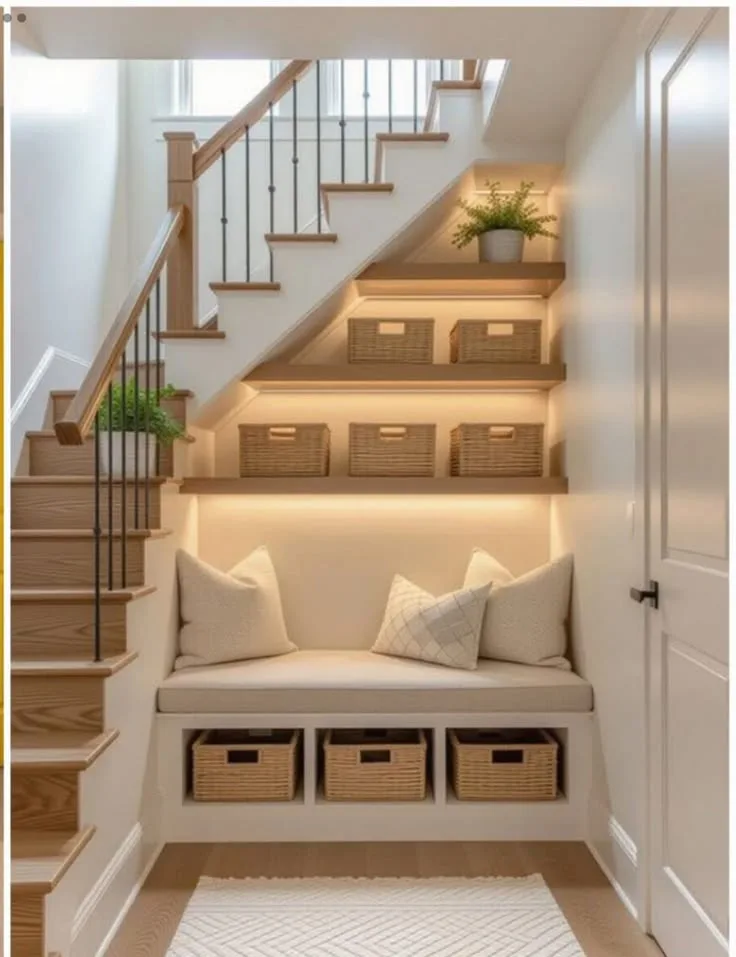
Image source: Bing (Web (fair-use with source credit))
Why a small landing is a measurement job before it's a design job
Think of the landing as three zones. There's the traffic path, which must stay clear. There's the handrail line, which must stay continuous.
And there's the leftover pocket, which is where your bench lives.
If that leftover pocket is less than 14 inches deep, you don't have room for a standard storage bench. You have room for a narrow shoe shelf or a floating bench with minimal depth.
The three numbers that decide everything: landing depth, stair width, headroom
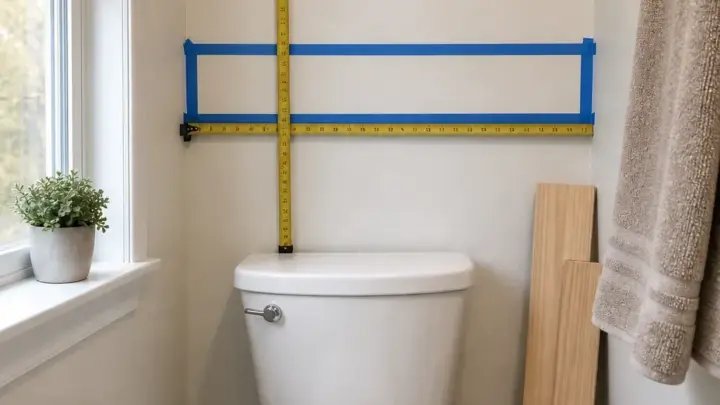
Measure these before anything else:
- Landing depth: floor space from the top riser to the facing wall
- Stair width: the clear walkway between walls or railings
- Headroom: vertical clearance above the treads
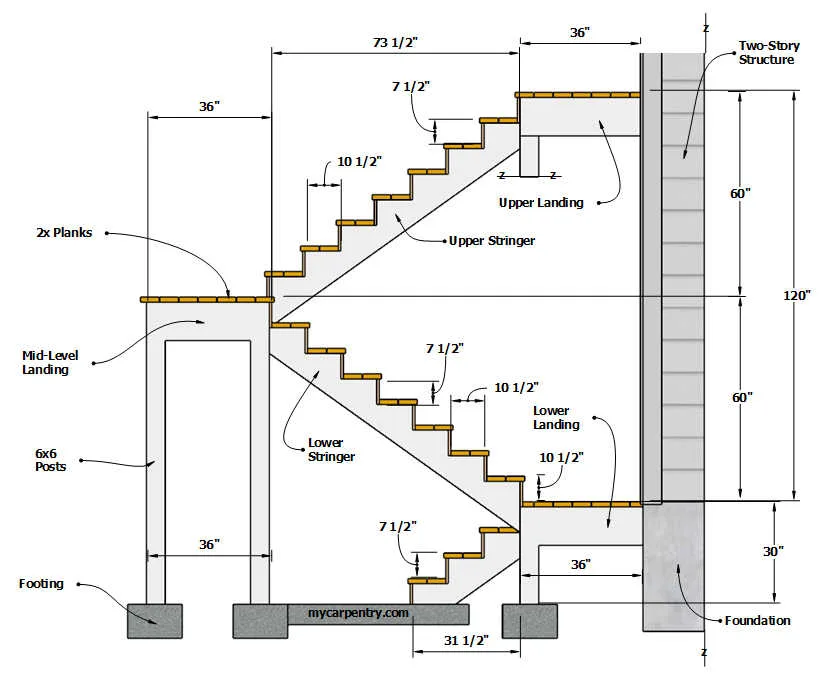
Image source: Bing (Web (fair-use with source credit))
If your landing depth is 36 inches and the stair width is also tight, you can't put an 18-inch bench across the full width. You'd leave just 18 inches for someone to walk through. That fails basic egress and it feels awful to use.
Why a standard 18-inch bench often won't fit, and what to do instead
A standard 18-inch deep storage bench assumes you have roughly 54 inches of landing depth to spare. Most small landings don't.
If you're short on depth, your options are:
- Go shallower: a 12 to 14 inch bench with flip-lid storage
- Go vertical: a wall-mounted floating bench, no floor footprint
- Go sideways: a bench along the side wall, not across the landing
- Go up: hooks and shelves instead of a floor bench
The Four Storage Bench Layouts That Work on a Landing
Not every bench design suits a landing. Hinge swing, drawer pull, and seat height all clash with tight spaces differently. Here are the four layouts that actually work, and who each one suits.
Flip-lid bench
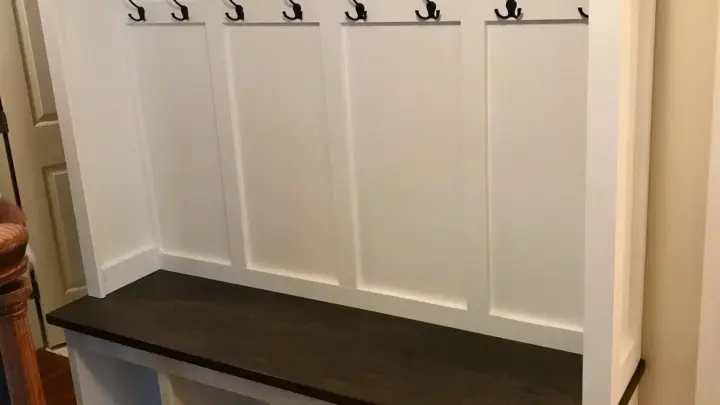
A flip-lid bench has a hinged seat that lifts to reveal a storage cavity underneath. It's the classic mudroom design and it works on landings because it has no drawer to pull out.
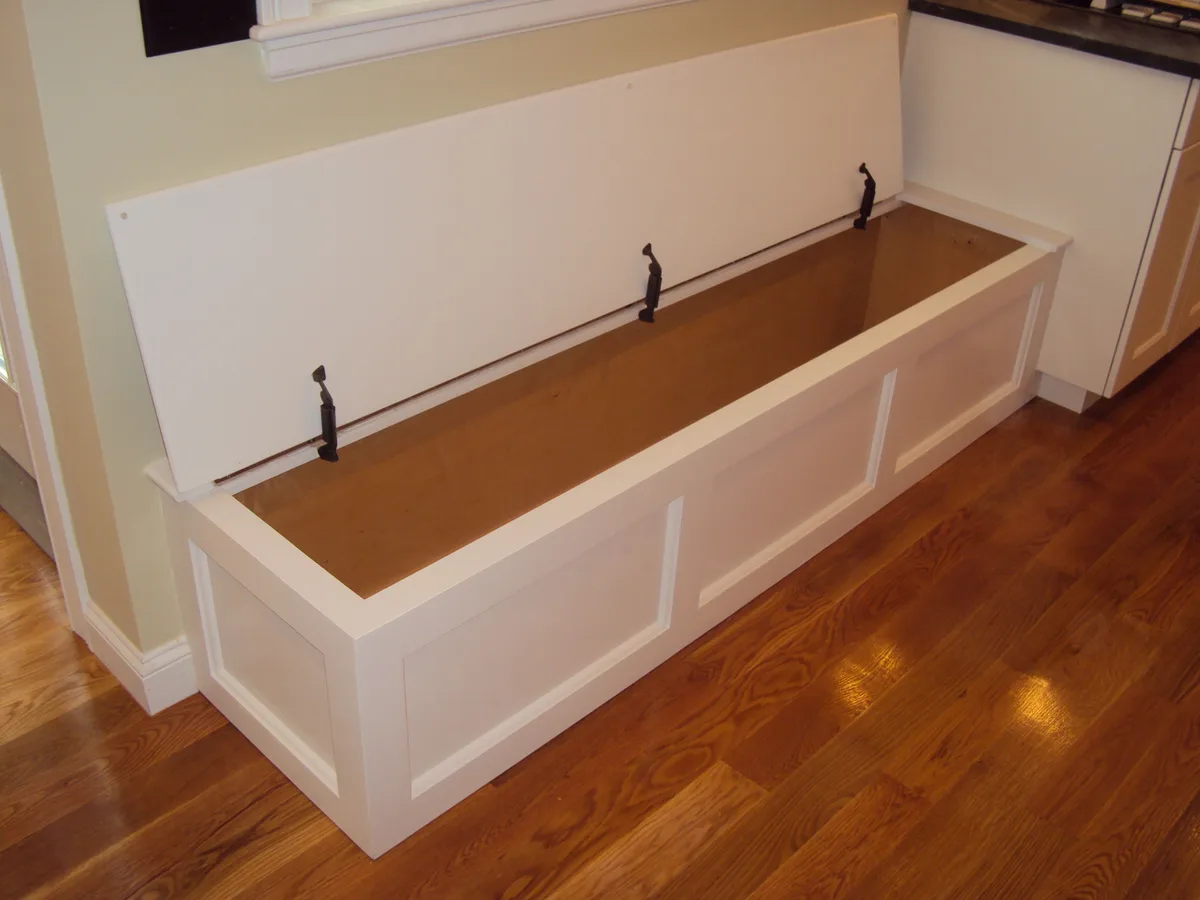
Image source: Bing (Web (fair-use with source credit))
The catch is lid clearance. A 30-inch wide lid hinged at the back needs about 30 inches of vertical space to open fully. If there's a window, a shelf, or a low ceiling above, the lid won't clear.
Gas-strut hinges help, but you still need the swing room.
Best for: shoes, blankets, and bulky items you don't reach for daily.
Drawer-under bench
A drawer-under bench stores items in pull-out drawers below the seat. It's more accessible than a flip lid because you don't have to clear the seat to open it.
The problem is the pull. A 20-inch deep drawer needs 20 inches of open floor in front to fully extend. On a narrow landing, that's often the traffic path.
You'd be pulling drawers into where people walk.
Best for: wider landings where the bench sits off the main path.
Open cubby bench
An open cubby bench has no lid and no drawers. Just shelves or compartments under the seat. It's the cheapest to build and the easiest to live with on a tight landing because nothing swings or slides.
Downside: everything is visible. If you want concealed storage, this isn't it. If you want easy grab-and-go shoe storage, this is the winner.
Best for: family homes, rental setups, and anyone who hates moving cushions to open a lid.
Floating or wall-mounted bench
A floating bench mounts directly to the wall with no legs. It occupies zero floor footprint beyond its own depth. On a landing where floor space is precious, this is often the smartest play.
You lose the under-seat cavity, but you can add shallow wall-mounted drawers or hooks above. It also keeps the floor visually open, which makes a small landing feel bigger.
Best for: very tight landings, renters using removable brackets, and anyone who wants the landing to stay visually light.
| Layout | Storage access | Floor space needed | Best for |
|---|---|---|---|
| Flip-lid | Lift seat | Lid swing room only | Bulky seasonal items |
| Drawer-under | Pull out | Full drawer depth clear | Off-path widers landings |
| Open cubby | None, open | None beyond bench | Daily shoes and bags |
| Floating | Wall drawers or hooks | None | Tight landings, renters |
Reading the Space: Visual Cues That Tell You What Will Fit
A sketch on paper beats a hundred product photos. Before you buy or build, map the landing in a simple top-down drawing. You don't need software.
Graph paper and a pencil work fine.
How to sketch your landing before you buy anything
Draw the landing as a rectangle. Mark the top riser on one side and the facing wall on the other. Now draw the handrail line and the door swing, if there's a door.
Then draw where you want the bench. This single sketch reveals almost every layout clash before it happens.
Hinge swing, drawer pull, and door clash: the three collisions people miss
These three issues cause most landing bench failures:
- Hinge swing: the lid arcs upward and backward. It needs vertical clearance above the seat.
- Drawer pull: the drawer extends forward. It needs horizontal clearance in front of the bench.
- Door clash: any door opening onto the landing sweeps an arc. The bench must sit outside that arc.
If a door opens onto your landing, check the swing radius first. A standard 30-inch door sweeps roughly a 30-inch quarter circle. That eats most of a small landing on its own.
Where the handrail, newel post, and window change the plan
The handrail must stay continuous and graspable. You cannot run a bench through it or block access to it. The newel post at the bottom or top of the stairs often sits exactly where you'd want the bench end.
A window on the landing changes things in two ways. It gives you a natural window seat bench opportunity. It also limits how high a flip lid can rise.
Clearance checks: egress width, headroom, and the bottom step
Run these checks before you commit:
- Is the full stair width still clear for walking?
- Is the handrail still fully graspable along its length?
- Does the bench intrude on the headroom over any tread?
- Does the bottom or top step have a clear landing to stand on?
- Can two people pass if needed?
If any answer is no, shrink the bench or change the layout.
Bench Specs That Matter (And the Numbers Behind Them)
Get the specs wrong and even a well-placed bench feels awkward. Here's what actually matters on a landing, with the numbers behind each choice.
Seat height, depth, and length ranges
| Spec | Typical range | Landing-friendly sweet spot |
|---|---|---|
| Seat height | 16 to 20 in | 17 to 18 in |
| Bench depth | 14 to 20 in | 12 to 16 in |
| Bench length | 24 in to full width | 30 to 42 in |
Seat height should let your feet rest flat when seated. If it's above 20 inches, most adults dangle. If it's below 16 inches, standing up gets awkward.
Materials: MDF vs. plywood vs. solid timber in real hallways
Landings sit in hallways, and hallways are humid. That matters for material choice.
- MDF: smooth finish, cheap, but swells when wet. Fine in dry, well-ventilated hallways.
- Plywood: more moisture-resistant, holds screws better, good mid-range option.
- Solid timber: durable, repairable, heavier. Best long-term choice but pricier.
If your landing is near a front door or a bathroom, avoid raw MDF. Plywood or moisture-resistant MDF is a safer call.
Lid hardware, soft-close hinges, and anchor points
Soft-close hinges stop a lid slamming on small fingers. Gas struts hold the lid open so you can use both hands. Both are worth the small extra cost.
Anchoring matters too. A freestanding bench should be fixed to the wall to stop it tipping. A child leaning on an unanchored bench can pull it over.
Per general stairway safety guidance from OSHA, keep walkways clear and secure anything that could shift.
Cost tiers: flat-pack, freestanding, and custom built-in
As of 2026, expect these rough ranges:
- Flat-pack storage bench: $80 to $250
- Freestanding mid-range bench: $250 to $700
- Custom built-in joinery: $800 to $3,000+
- DIY build (plywood, fixings, paint): $60 to $200
Flat-pack is the fastest route. Custom is the best fit for an awkward landing. DIY sits in the middle if you're comfortable with basic carpentry.
Flat-Pack, Freestanding, or Built-In? Picking Your Route
The right choice depends on three things: how tight your landing is, whether you rent, and how long you plan to stay. Here's how to decide.
When flat-pack makes sense
Choose flat-pack if you want storage fast, your landing has a standard rectangular pocket, and you don't mind a visible unit. It's also the right call if budget is tight or you might move within a couple of years.
Flat-pack benches are usually 15 to 18 inches deep. That's fine on a landing of 42 inches or more in depth. It's too deep on anything tighter.
When freestanding beats fixed
Freestanding wins when you want flexibility. You can shift it, resell it, or take it with you. It also suits weird shapes, like an L-shaped landing, because you can angle it.
The trade-off is stability. A freestanding bench on an uneven hallway floor will wobble. Fix it to the wall or add rubber feet.
When custom joinery earns its price
Custom joinery pays off when your landing is unusual. Sloped ceilings, odd corners, a window at seat height, or a handrail that cuts through the space. A joiner can design around all of it.
It also gives you a seamless look. A built-in bench with matching skirting and a hidden lid reads like part of the house, not an afterthought.
What renters should do differently
Renters need reversible solutions. A permanent built-in becomes a landlord negotiation and often a lost deposit.
Stick to freestanding benches, floating benches on removable brackets, or slim cubbies that sit against a wall. Avoid drilling into the handrail or main structural walls. Tiny screw holes filled with filler are manageable.
Structural changes aren't.
If it's your home and you're changing the stairs, check ICC building codes guidance for the current IRC requirements before you start.
Planning the Fit Step by Step
Good landings get planned on paper first. Follow this order and you'll avoid most of the mistakes covered later.
Measure, sketch, check code, then commit
Measure the landing depth, the stair width, and headroom over the treads. Sketch the top-down layout, marking the handrail line and the door swing. Check the full stair width stays clear.
Only then do you pick a bench.
Build or buy, anchor, and finish
If you're buying, verify the unit's depth against your usable pocket. If you're building, cut the carcass to the pocket size, not to a standard dimension. Then anchor the bench to the wall with brackets or L-brackets.
Finish the seat before anchoring if you're painting or staining. A painted bench can't move once it's fixed. Seal the underside in humid hallways.
Adding hooks, shelf, or light above the bench
Above the bench, add a coat hook rail or a shallow shelf. Keep the shelf around 6 to 8 inches deep so it doesn't crowd the stairs. A small LED strip light under the shelf helps at night and stops the landing feeling like a dark void.
Mistakes That Turn a Good Bench Into a Bad One
These are the errors that show up over and over in small-landing builds. Each one is easy to avoid if you catch it during planning.
Blocking the escape route or handrail
A bench that narrows the stair walkway or interrupts the handrail fails safety basics. The handrail must stay graspable for its full run. If your bench covers or blocks it, shift the bench to a side wall or drop the idea.
Choosing a lid that can't fully open
A flip lid needs full vertical swing to open. If there's a window, shelf, or low ceiling above the seat, the lid will hit it. Check lid clearance before buying.
Gas struts and front-access designs sidestep this entirely.
Cheap materials in damp hallways
Hallways pick up moisture, especially near a front door. Raw MDF swells and loses its shape when it gets damp. Use plywood, moisture-resistant MDF, or solid timber if your landing sits in a humid spot.
Letting the bench become a dumping ground
The open-cubby bench is the easiest to use and the fastest to become messy. If your family drops bags and shoes without looking, add labelled bins or dividers. Closed storage hides the mess but gets forgotten.
Pick based on how your household actually behaves.
Safety, Code, and Clearance Basics
Safety rules for landings aren't suggestions. They protect people using the stairs every day.
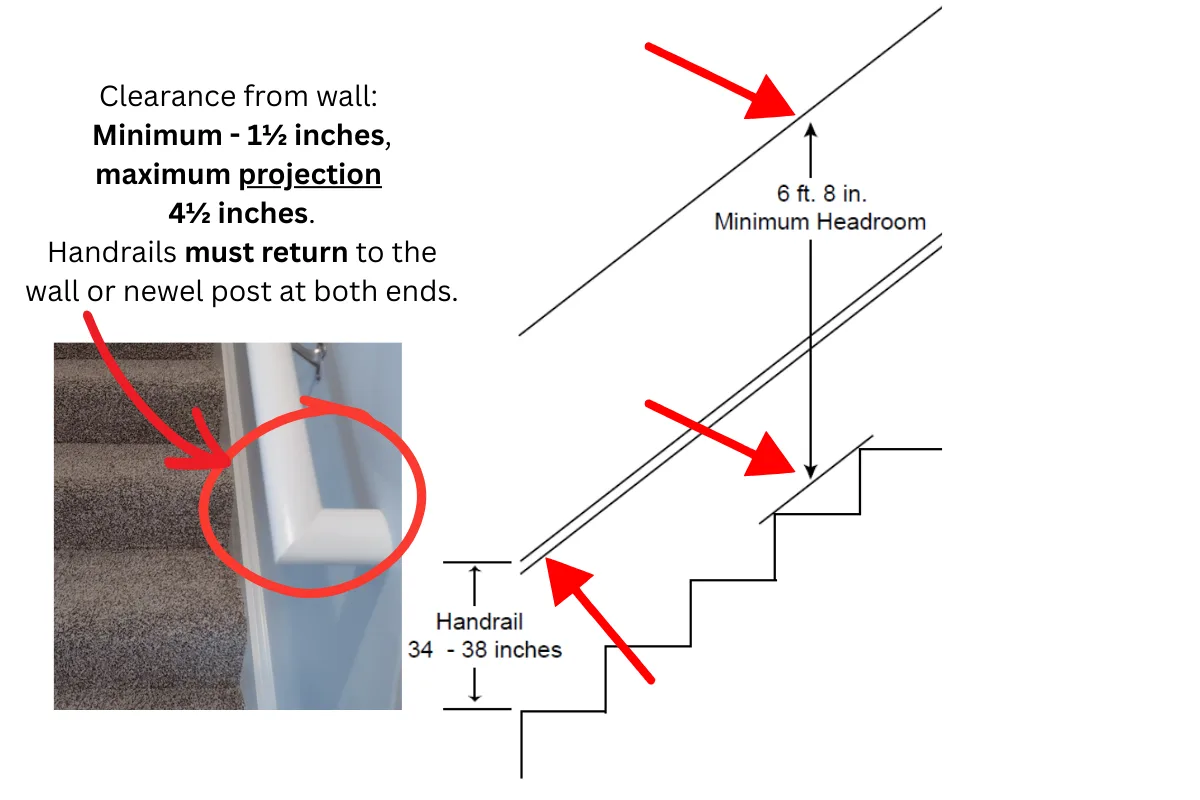
Image source: Bing (Web (fair-use with source credit))
IRC and UK Building Regs in plain terms
US stairs follow the International Residential Code. It sets the 36-inch minimum stair width and the 6-foot-8-inch headroom figure. UK stairs follow Approved Documents K and B, which cover stair dimensions and fire escape.
If you're adding a fixed bench, don't reduce the stair width below the minimum. That's the one rule that voids most landing bench plans.
Headroom, egress width, and handrail continuity
Headroom stays above the treads, not the landing. A bench that raises the floor or narrows the top step can still fail. Egress width is the clear walking path.
Keep it fully open. The handrail must be continuous and graspable, with no bench crossing it.
Child safety: lid stays and tip-over anchoring
Soft-close hinges and lid stays stop lids slamming on fingers. Anchor the bench to the wall if it's freestanding. A child leaning on an unanchored bench can pull it over.
If your landing is on a main escape route, avoid anything that blocks the path in a fire.
FAQs
What's the minimum landing depth for a bench with storage?
You need at least 14 to 16 inches of clear landing depth beyond the stair walkway. Standard storage benches run 14 to 18 inches deep. If your landing depth is under 36 inches total, a shallow floating bench or wall hooks are the safer call.
Can I put a bench on a landing if it narrows the stair width?
No. A bench must not reduce the stair width below the code minimum, which is 36 inches in most US homes. If your bench would narrow the walkway, use a wall-mounted design with zero floor footprint instead.
Is a flip-lid or drawer bench better for shoes?
Flip-lid is better for shoes on a tight landing. It needs no floor space in front. Drawer benches need the full drawer depth open, which blocks narrow landings.
If you reach for shoes daily, open cubbies beat both.
How much does a small landing bench cost?
As of 2026, flat-pack storage benches run $80 to $250. Freestanding mid-range units sit at $250 to $700. Custom built-ins start around $800 and climb past $3,000.
A DIY build using plywood, fixings, and paint typically lands between $60 and $200.
Do I need planning permission or a permit?
In most cases, no permit is needed for a freestanding or non-structural bench. You may need one if you're altering the stairs, changing a railing, or modifying a load-bearing wall. Check with your local building authority before making any structural changes.
Final Decision Guide: Matching Bench to Landing
Use these quick matching rules to pick the right bench for your landing type.
Small landing, tight clearance
Go floating or shallow cubby. Keep the bench depth under 14 inches. Add wall hooks and a slim shelf above.
Skip any drawer design, no matter how nice it looks.
Medium landing, family use
A flip-lid bench with soft-close hinges handles shoes, coats, and bags. Keep it to one side of the walkway, not across the full width. Pair it with a low hook rail above.
Landing with a window
Build a window seat bench that doubles as storage. Use a hinged lid if the window sill sits high enough. If not, use lift-off cushions and open storage underneath.
Rental or temporary setup
Pick freestanding or removable-bracket floating benches. Nothing drilled into structural walls. Fill small screw holes when you move out.
Avoid heavy built-ins you can't take with you.
When in doubt, do less
A clear landing with good hooks and a slim shoe rack beats a cramped, awkward bench. Landings are working spaces first. Storage is a bonus, not the point.
Final Decision Guide: Matching Bench to Landing
Treat the landing as the decision-maker, not the bench.
Small landing, tight clearance
Go floating or shallow cubby. Keep depth under 14 inches. Add wall hooks and a slim shelf above.
Skip drawer designs entirely, no matter how good they look.
Medium landing, family use
A flip-lid bench with soft-close hinges handles shoes, coats, and bags. Keep it to one side of the walkway, not across the full width. Pair it with a low hook rail above.
Landing with a window
Build a window seat bench that doubles as storage. Use a hinged lid if the sill sits high enough. If not, go with lift-off cushions and open storage underneath.
Rental or temporary setup
Pick freestanding benches or floating units on removable brackets. Don't drill into structural walls. Fill small screw holes when you move out, and skip anything you can't take with you.
When in doubt, do less
A clear landing with good hooks and a slim shoe rack beats a cramped, awkward bench. Landings are working spaces first. Storage is a bonus, not the point.

Similar Posts