Small Bedroom Makeup Vanity Ideas That Fit
If you're trying to fit a makeup vanity in small bedroom space, the first thing to accept is that the furniture itself is rarely the problem. The real problem is the wall you're picturing, the door that swings into it, and the outlet that sits three feet away from where you need it.
In our research, we found that most compact vanities fall between 24 and 48 inches wide, and the working walkway beside them needs 30 inches minimum to feel comfortable. That leaves very little margin for error. Manufacturer specifications, lease terms, and room geometry decide your setup before your taste does.
makeup vanity in small bedroom
A makeup vanity in a small bedroom works best when you match the type to your wall, not your wishlist. Renters should skip wall drilling and use freestanding or over-door options. Owners with free wall space can mount a floating vanity.
Rooms with no spare wall need a corner unit or a portable caddy. Measure your walkway first.
Start Here: The 4 Questions That Decide Everything
Before you look at a single product listing, answer four questions. Your answers will point you to one category of vanity and eliminate the rest. In our analysis, skipping this step is the single biggest reason people buy the wrong unit and return it.
Question 1: How much clear wall do you actually have?
Clear wall means wall space that isn't blocked by a door swing, a closet opening, a window, or an air vent. A bedroom door needs roughly 32 to 36 inches of swing radius. If your only free wall sits behind a door, you don't have clear wall.
You have a traffic zone.
Measure the wall width and subtract anything that swings, opens, or vents into it. What's left is your real working space. Most compact vanities need at least 30 inches of that clear span.
Question 2: Can you drill into the walls?
This is the rental question, and it decides almost everything. If you rent and your lease bans drilling or wall anchors, a floating vanity is off the table entirely. If you own the place, or your lease allows picture-hanging anchors, wall-mounted options open up fast.
Check your lease before you shop. Repair costs for patch-and-paint on move-out typically come out of your deposit, and a heavy vanity can leave damage that's hard to hide.
Question 3: Is there an outlet within reach?
A vanity with no power nearby becomes a shelf. Hair dryers, straighteners, and LED mirrors all need an outlet. A six-foot cord on a mirror won't reach a wall socket across the room.
Walk the room and count outlets. If the only one sits on the opposite wall, you have three options: a heavy-duty extension cord run along the baseboard, a battery-powered mirror, or a different wall.
Question 4: Does the room need to do double duty?
If your bedroom is also your office, a plain vanity wastes surface area. A vanity desk with a flip-up mirror gives you a work surface by day and a grooming station by night. That dual-purpose logic changes which unit makes sense.
| Your Answer Set | Recommended Vanity Type | Floor Space Used |
|---|---|---|
| No drilling, free wall, outlet nearby | Over-door or freestanding compact | None to 2 sq ft |
| Can drill, clear wall, outlet nearby | Wall-mounted floating vanity | None |
| Can drill, no clear wall, has corner | Corner vanity | 1 to 2 sq ft |
| No wall, no drill, tight budget | Portable caddy or tray | None |
| Needs to work as a desk too | Vanity desk with flip-up mirror | 3 to 4 sq ft |
Answer those four questions honestly and you'll already know which of the branches below applies to you.
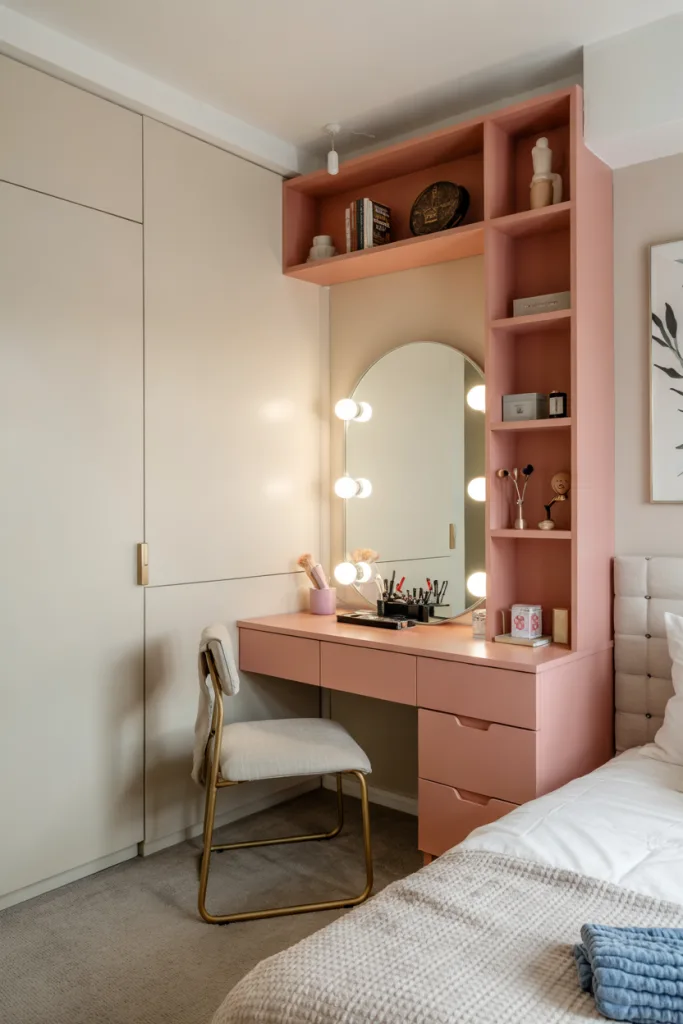
Image source: Bing (Web (fair-use with source credit))
Branch 1: You Rent and Can't Drill Into Walls
If your lease bans wall damage, you're working with removable, freestanding, or over-door options. These three categories cover almost every rental situation, and none of them require a single hole in the wall.
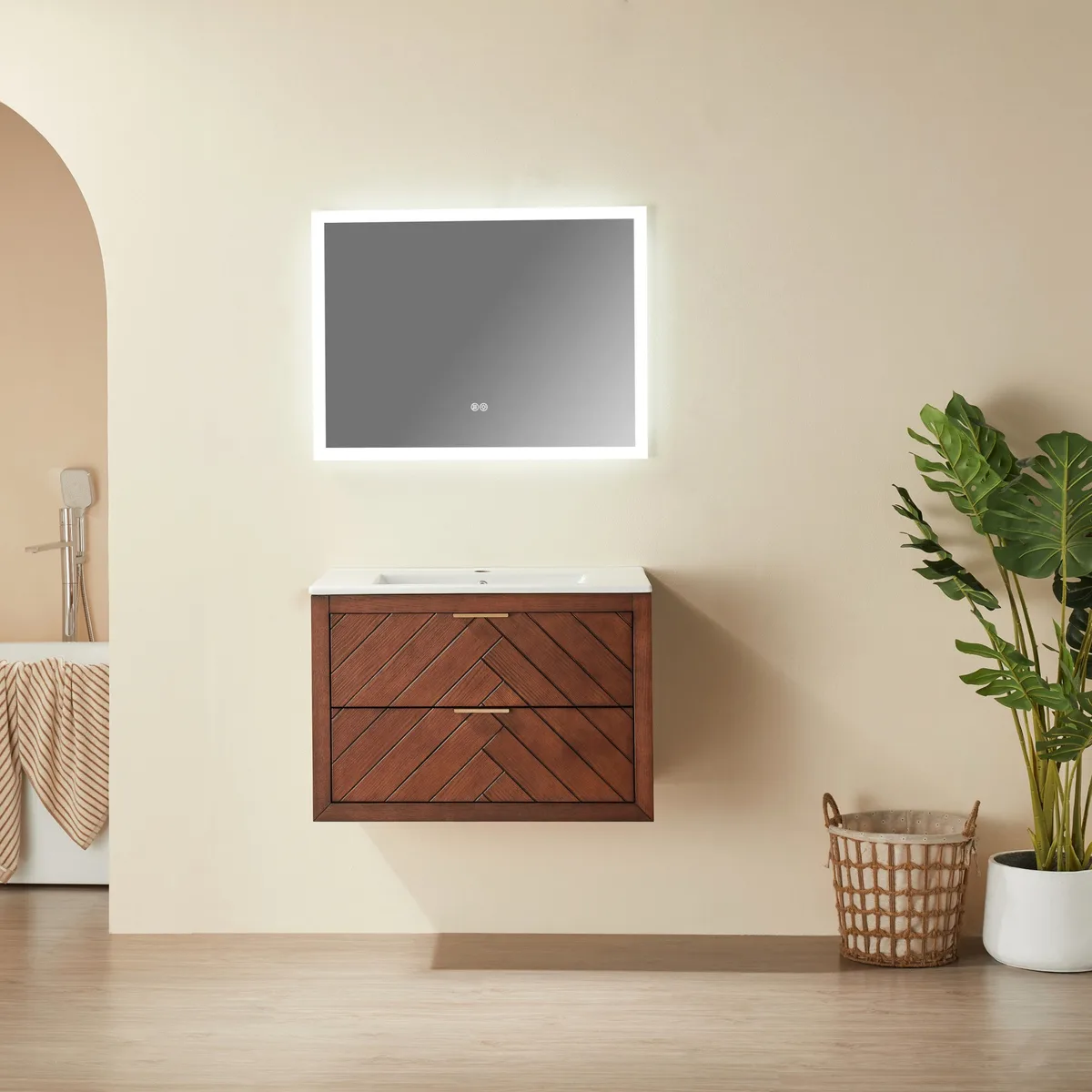
Image source: Bing (Web (fair-use with source credit))
Over-the-door hanging vanity
This is the zero-commitment option. It hangs on the back of a bedroom or closet door and comes off in seconds when you move out. Storage is limited, usually a few shallow pockets and a small shelf, but it solves the "I have no surface at all" problem.
Aggregate reviews report that the main failure point is door thickness. Standard interior doors run about 1.375 inches thick. Measure yours before ordering, and check the weight rating on the door hinges.
Compact freestanding vanity
A freestanding unit in the 30 to 36 inch range gives you real drawers and a proper mirror without touching the wall. You give up about two to three square feet of floor, so walkway clearance becomes the deciding factor. Aim for 30 inches of clear path beside it.
Portable caddy or tray
If you share a bathroom and just need somewhere to set your brushes, a portable caddy costs very little and stores under the bed. It won't give you a seated station, but it keeps your collection organized and out of the way.
What to watch for on a rental
- Anchor any tall freestanding unit to the wall with a removable adhesive strap if the lease allows it.
- Keep cords along baseboards, not across walkways.
- Photograph the wall before and after, so you can prove no damage at move-out.
The trade-off here is storage capacity. Renters typically get less drawer space than owners, so organizers and risers inside the drawers matter more.
Branch 2: You Own the Place and Can Mount to a Wall
Owning the space changes the math completely. You can mount a floating vanity, and that means zero floor footprint. For a genuinely small bedroom, this is usually the cleanest solution.
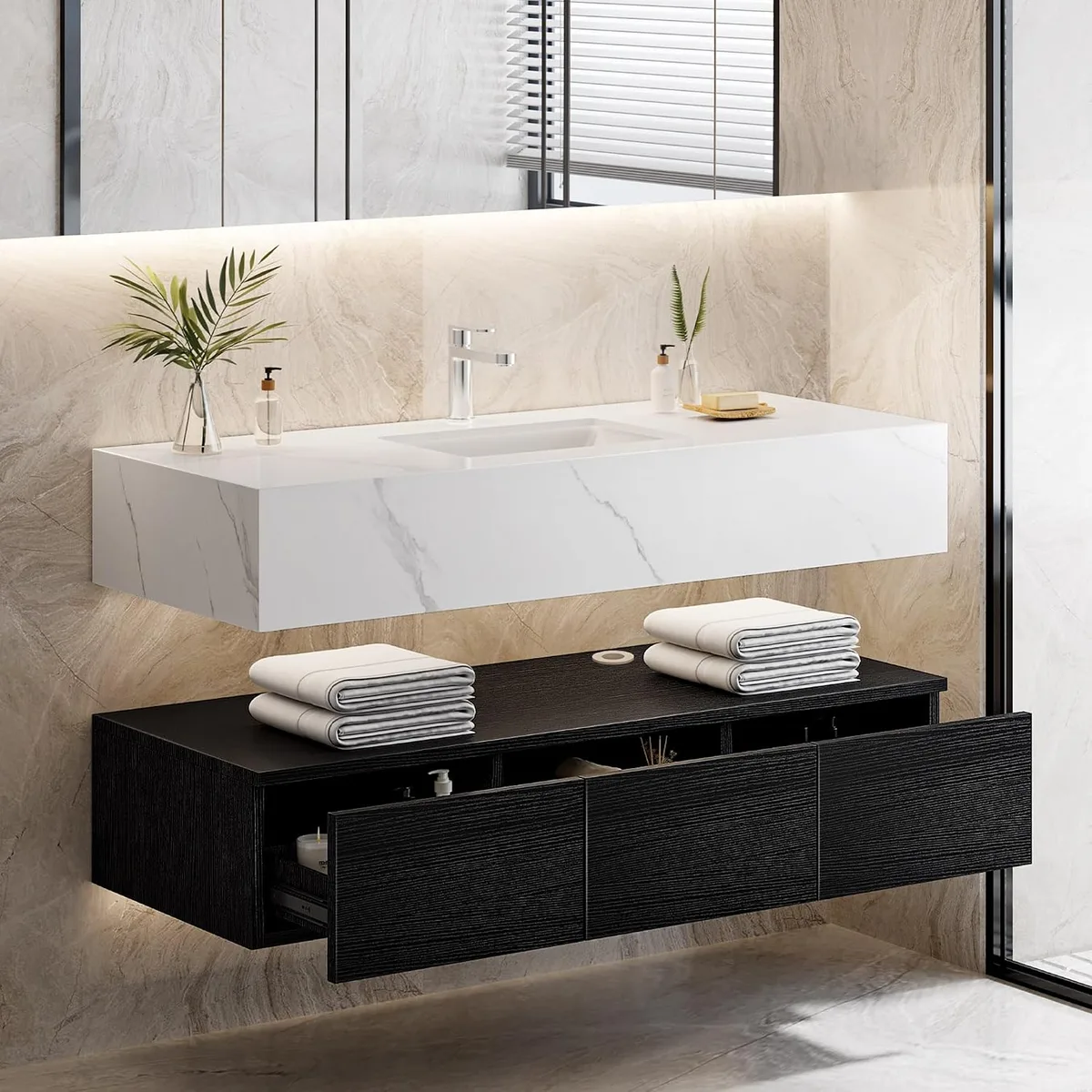
Image source: Bing (Web (fair-use with source credit))
Why floating works so well in tight rooms
A wall-mounted unit keeps the floor open. That visual and physical clearance makes a small room feel bigger, and it removes the trip hazard a stool or table legs create. In our research, floating vanities consistently score highest for small-room use.
The anchor problem most people get wrong
Here's where it goes sideways. A loaded floating vanity can weigh 50 to 80 pounds once you add drawers, bottles, and tools. Drywall anchors alone won't hold that.
Manufacturer specifications almost always call for mounting into wall studs or using heavy-duty toggle bolts rated for the load.
Find the studs with a stud finder. If the studs don't line up with your vanity brackets, use toggle bolts rated well above the total weight. When in doubt, hire someone to mount it.
A vanity that pulls out of the wall takes your deposit-free wall and your cosmetics with it.
Choosing the right size
Floating vanities commonly come in 24, 30, 36, 40, and 48 inch widths. In a small bedroom, 30 to 36 inches is the sweet spot. It fits a mirror, a couple of drawers, and a stool without crowding the bed.
Depth matters too. A shallow 12 to 16 inch depth keeps the walkway open. A deep 18 to 20 inch unit eats floor you probably can't spare.
Lighting before you mount
Plan your lighting before drilling anything. An LED mirror rated CRI 90 or higher shows foundation and blush shades accurately. Color temperature around 3000K to 4000K gives you neutral light.
Warm bulbs push foundation orange, and cool bulbs make it look grey.
Per UL listings, make sure any electrical component carries a recognized safety mark. A cheap unlisted mirror is a fire risk, not a bargain.
Branch 3: You Have No Free Wall at All
Some bedrooms have no usable flat wall. Doors, closets, and windows eat every inch. If that's your room, don't force a vanity onto a wall that can't take one.
Repurpose instead.
Corner vanity
A corner unit uses the dead space most rooms waste. Typical corner vanities take up one to two square feet and often come as a triangular or L-shaped design. They still need an outlet nearby, so check the corner for power before committing.
Closet-converted vanity
If you have a reach-in closet you don't fully use, converting part of it into a vanity nook is one of the smartest small-room moves. You get built-in walls on three sides and often an outlet if the closet shares a circuit with the room.
Measure the closet depth first. You need enough room to sit and close the door, or you commit to leaving the door open.
Bedside table as vanity
If floor space is truly gone, a bedside table with a drawer can double as a tiny vanity. It won't hold a full collection, but it handles daily essentials. Add a wall-mounted or clip-on mirror and a compact light.
The honest limitation
Every option in this branch trades storage or comfort for space. You will not get a Hollywood mirror setup and a full drawer stack in a room with no wall. Pick the compromise that bothers you least.
Branch 4: Your Bedroom Doubles as a Workspace
If your bedroom is also your office, don't buy two pieces of furniture. Buy one that does both. A vanity desk with a flip-up mirror is the obvious pick here.
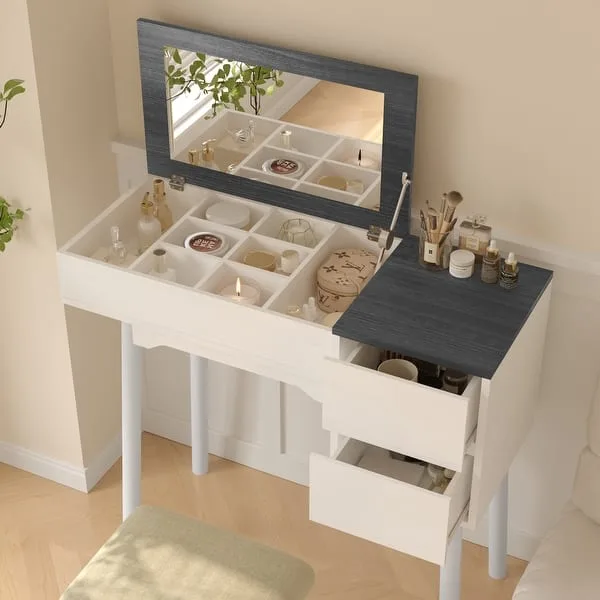
Image source: Bing (Web (fair-use with source credit))
How a flip-up mirror desk works
The mirror folds down into the desktop when not in use, leaving a flat work surface. When you need to get ready, you flip it back up. You get a desk and a vanity from the same footprint, which is the whole point in a small room.
Where to place it
Put it where you'd put a desk: near an outlet, ideally with some natural light from a window. If the window light is strong and consistent, you may not need a lit mirror at all. If it's dim or indirect, add a task light.
The workspace trade-off
Cord management gets messy fast when you mix a laptop charger, a monitor, a hair dryer, and an LED mirror on one desk. Use an under-desk power strip with surge protection, and route cords through a clip or sleeve. OSHA's general cord-safety guidance applies here too.
Keep cords out of walkways and away from heat.
Keeping the two uses separate
Store beauty tools in a drawer insert or a small caddy you can lift out when you switch to work mode. That ten-second swap keeps the desk from becoming a permanent clutter pile.
As of 2026, dual-purpose vanity desks remain the most recommended solution for studio apartments and small bedrooms that pull double duty as offices.

Similar Posts