Muted Green Bathroom Vanity Ideas That Transform
Muted green bathroom vanities keep showing up in the most photographed bathrooms for one reason. The color calms a small room without making it feel flat. But muted green is a chameleon.
The same sage reads elegant in a bright south-facing bath and sickly under a warm bulb in a windowless powder room.
That's the catch most people don't expect. Paint manufacturers publish a Light Reflectance Value (LRV) for every color, and that number plus your room's lighting drives the result far more than the swatch on the chip. In our research, the shade on the can and the shade on your cabinet are rarely the same.
Here's how to close that gap before you commit.
muted green bathroom vanity
A muted green bathroom vanity is a vanity cabinet painted or finished in desaturated green. Common shades include sage, olive, eucalyptus, seafoam, and forest green. The muted tone means lower saturation, so the green reads softer than a bright or jewel green.
It pairs well with brass, black, or nickel hardware. White quartz and marble countertops keep it balanced.
Why Muted Green Is Trickier Than It Looks (And Why That's a Good Thing)
The color shifts with everything around it. Change the bulb, change the counters, change the floor, and the green changes with them. That's not a flaw.
It's the whole reason muted greens look custom rather than store-bought.
Lighting is the biggest lever. A warm 2700K bulb pushes sage toward yellow and olive. A cool 4000K bulb pulls the same green toward gray and blue.
North-facing rooms render muted greens cool and flat. South-facing rooms bring out warmth and depth.
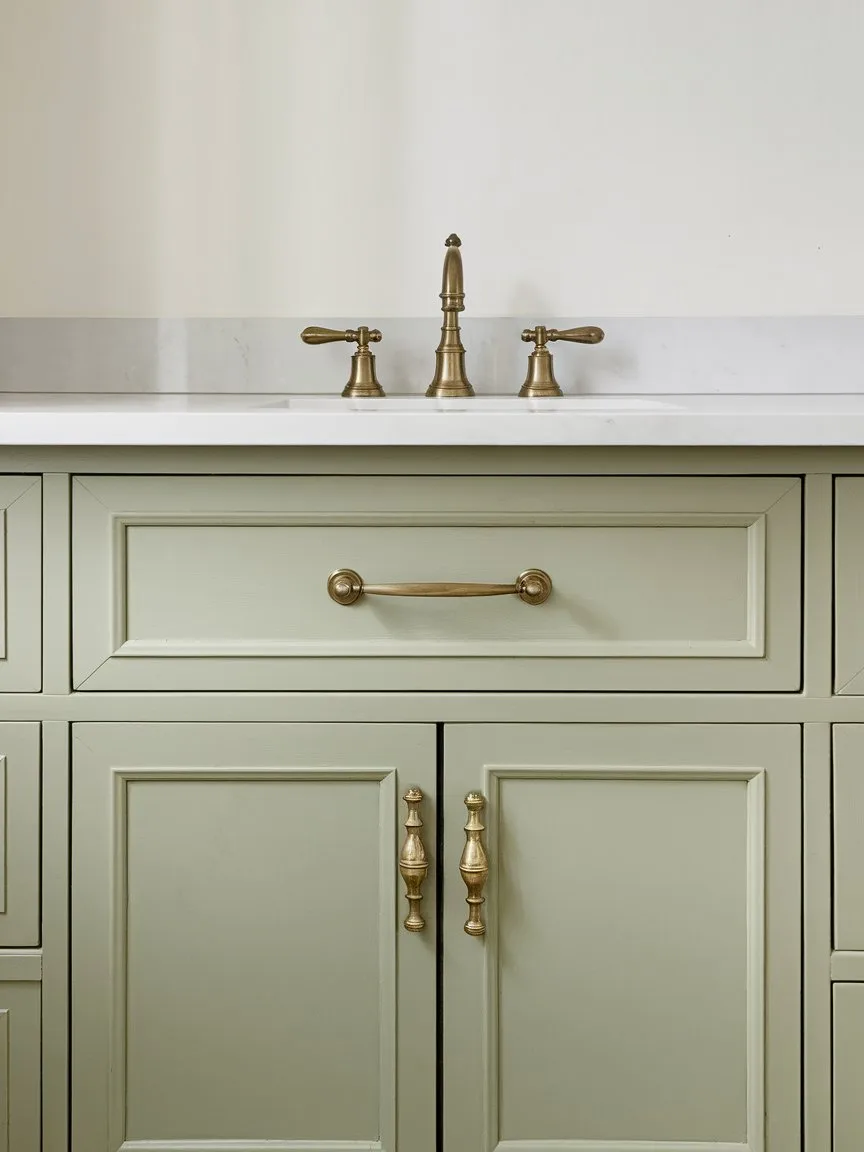
Image source: Bing (Web (fair-use with source credit))
Manufacturer specs confirm most bathroom paint reaches full hardness in 7 to 30 days. Until then, the green keeps reading slightly lighter than it will settle.
If you want the calm, spa-like effect, you have to test the actual shade on the actual cabinet. Schedule that test for both morning and evening. If you skip it, you're guessing.
The Muted Green Family: Sage, Olive, Eucalyptus, Seafoam, and Where They Actually Land
Sage, olive, eucalyptus, and seafoam all sit under the muted green umbrella. They only look similar on a small chip. On a full cabinet run, the undertones take over.
Warm Undertones: Olive, Thyme, Moss
Olive, thyme, and moss carry yellow and brown. They lean earthy and look best with warm light, wood floors, and brass hardware. In a cool room, an olive can turn muddy and gray.
Cool Undertones: Sage, Eucalyptus, Seafoam
Sage, eucalyptus, and seafoam carry blue and gray. They read clean and coastal. Pair them with white quartz, cool nickel, and lots of daylight.
In a dark powder room, keep them light, or they'll flatten out.
Deep and Moody: Forest, Juniper, Evergreen
Forest, juniper, and evergreen land at the dark end. They make a big statement in a small space. They're also the toughest to photograph and the fastest to date if you pair them wrong.
Go deeper only when the room has real light.
Reading LRV Before You Commit
LRV runs from 0 (pure black) to 100 (pure white). Light muted greens sit around 55 to 70. Deep muted greens drop to roughly 10 to 25.
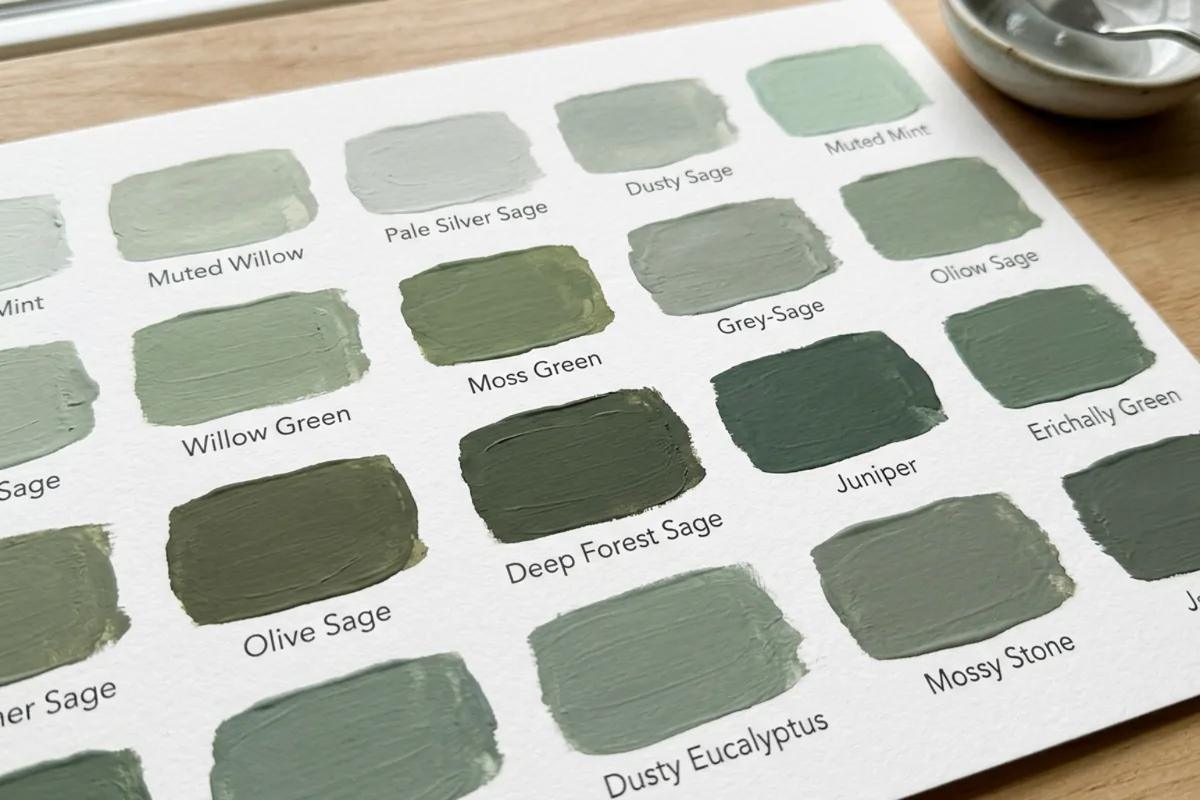
Image source: Bing (Web (fair-use with source credit))
Here's the practical rule. If your bathroom has limited natural light, stay above 50. If it's bright and open, anything goes.
| Shade | Undertone | Typical LRV Range | Best Lighting |
|---|---|---|---|
| Seafoam | Cool | ~65–70 | Bright, daylight |
| Sage | Cool-neutral | ~55–65 | Mixed |
| Eucalyptus | Cool | ~50–60 | Mixed, bright |
| Olive | Warm | ~30–45 | Warm, sunny |
| Forest / Juniper | Deep warm-cool | ~10–25 | Plenty of natural light |
How Lighting Rewrites the Color (North vs. South, Day vs. Night)
The same green can look like two different paints by lunchtime. This is where most people get burned.
North-facing bathrooms lean blue and cool. Muted greens feel quieter, cooler, and sometimes a bit dull. Warm brass fixtures and a 3000K bulb pull the color back.
South-facing bathrooms flood with warm daylight. Warm undertones glow and cool ones read crisp. You have more freedom here.
Reverse the logic for east- and west-facing rooms. East runs cool in the morning. West runs warm and golden in the afternoon.
Bulb Temperature: 2700K vs. 3000K vs. 4000K
- 2700K: Warm, yellow. Pushes greens toward olive. Good for cozy, moody baths.
- 3000K: Neutral warm. The safest all-around pick for a muted green vanity.
- 3500K, 4000K: Cool, crisp. Pulls green toward blue-gray. Good in bright rooms, risky in dark ones.
The Sample-on-the-Cabinet Test
Paint a 12-inch patch on a cabinet door, not on a chip in the showroom. Live with it for three days. Check it at night under your real bulbs.
Check it again on a cloudy day. If it holds up in both, you've found your green. If it turns gray at night, you haven't.
Pairing Muted Green With Tile, Countertops, Hardware, and Floors
Get the surrounding materials right and the green does most of the work. Get them wrong and even a perfect shade falls flat.
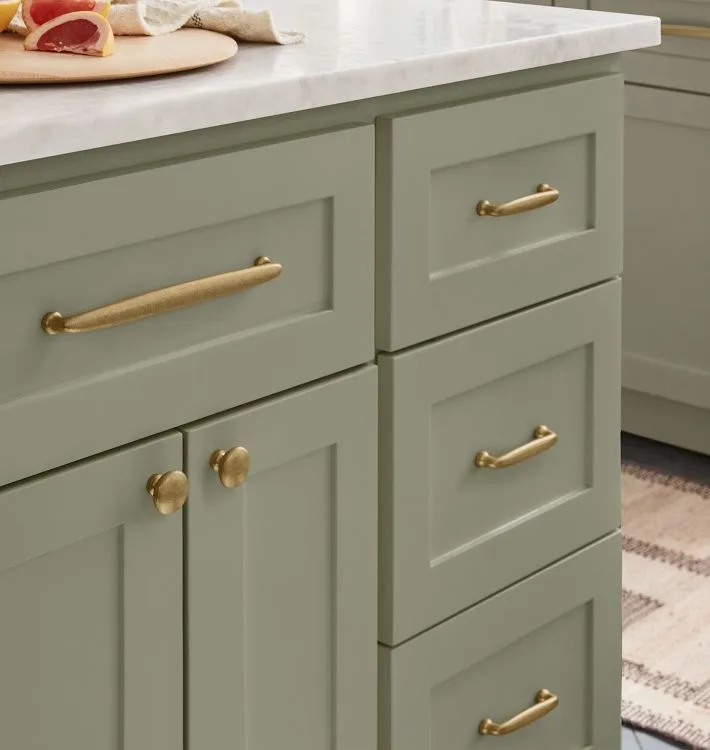
Image source: Bing (Web (fair-use with source credit))
Countertops: White Quartz, Marble, Soapstone, Butcher Block
- White quartz: The cleanest contrast. Lets the green be the hero.
- Marble: Classic with sage and eucalyptus. Veining adds softness.
- Soapstone: Dark and moody. Best with forest and juniper greens.
- Butcher block: Warm and casual. Works with olive and moss.
Hardware: Brass, Black, Nickel, Bronze
Warm brass lifts warm greens like olive and moss. Unlacquered brass gains a patina over time and suits a natural look. Matte black is the safest modern pick and works with nearly any green.
Polished nickel pops against deep forest. Bronze sits between brass and black and reads warm and earthy.
Backsplash and Floor Tile
White subway tile keeps things simple. Zellige tile adds texture and picks up the moody feel. Skip any tile with a strong green cast.
Two greens in one room can fight unless they clearly match. Wood-look porcelain floors soften the whole scheme.
Wall Color and Mirrors
Keep walls quiet. Cream, warm white, or a soft greige lets the vanity stand out. If you want color drenching, paint the walls and trim the same green one or two shades lighter.
That's a bold move that works best in a large bathroom. Round or arched mirrors soften the straight lines of a shaker cabinet.
Choosing the Right Vanity Style and Size for Your Bathroom
Style and size come first, color second. A muted green vanity can't save a cabinet that crowds the doorway or disappears into a wall.
Shaker vs. Flat-Panel vs. Beadboard
Shaker is the safest pick. Its recessed center panel gives muted green depth, and the flat rails feel classic. Flat-panel (slab) fronts look modern and make light greens read cleaner.
Beadboard adds cottage charm and works best with sage, seafoam, and coastal bathrooms.
Floating vs. Freestanding vs. Single vs. Double
- Floating: Wall-mounted, more floor visible, makes a small bath feel bigger. Needs solid wall blocking for weight.
- Freestanding: Sits on the floor, easier to install, hides plumbing neatly.
- Single: Best for powder rooms and bathrooms under 40 sq ft.
- Double: Needs at least 60 inches of wall and two sinks spaced around 30 inches apart.
Common Sizes: 24", 30", 36", 48", 60", 72"
Standard vanity depth runs 21 to 22 inches. Height lands at 32 to 36 inches, with 36-inch comfort-height the current default for adults.
| Width | Sinks | Best Room |
|---|---|---|
| 24"–30" | Single | Powder room, small bath |
| 36"–48" | Single | Standard guest or primary bath |
| 60"–72" | Double | Large primary bath |
If you're replacing a vanity in the same footprint, measure the plumbing rough-in before you buy. Moving a drain adds real cost and usually needs a plumber.
Paint It Yourself or Buy It Finished? Costs, Materials, and What Lasts
DIY painting runs roughly $50 to $150 in materials. A prefinished muted green vanity runs $300 to $3,000+, depending on size and build. The math favors DIY, but only if you prep properly.
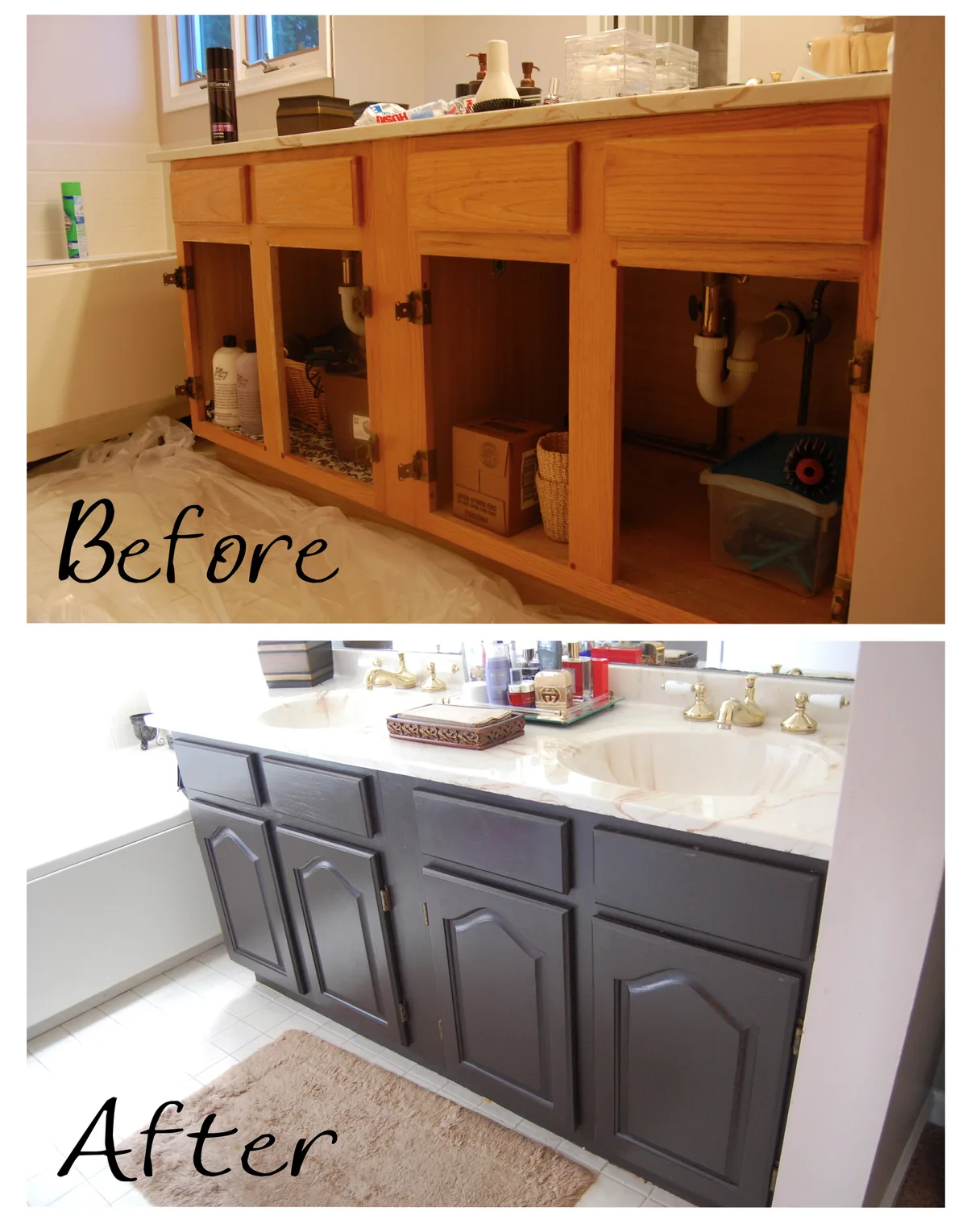
Image source: Bing (Web (fair-use with source credit))
The Paint Process That Actually Lasts
- Remove doors, drawers, and hardware.
- Degrease every surface. Bathrooms collect soap film and skin oils.
- Sand lightly to dull the sheen.
- Prime with a bonding primer, especially on factory finishes.
- Apply two to three thin coats, sanding lightly between coats.
- Topcoat with a moisture-resistant sealer.
Per EPA guidance, use low-VOC or zero-VOC paint in bathrooms and ventilate well. If your home was built before 1978, follow the EPA Renovation, Repair, and Painting Rule before sanding any painted surface.
When Buying Finished Makes More Sense
Buy prefinished if you need a specific size, want soft-close hardware, or don't have a garage to paint in. Buy prefinished if the vanity is under warranty. Painting it yourself can void that warranty.
DIY makes sense when the cabinet is solid wood, the size fits your room, and you're willing to spend a weekend on prep.
Mistakes That Make Muted Green Look Dull, Muddy, or Dated
The most common mistake is picking green from a photo. Screens distort color. A shade that looks perfect on Pinterest can read washed-out in your actual bathroom.
The second mistake is ignoring the countertop and floor. A cool sage against warm beige tile turns the green gray. A deep forest against dark granite disappears into a dark corner.
Match undertones, not just colors.
The third mistake is skipping the paint sample. Always paint a patch on the cabinet, not on the wall. Bathroom humidity and lighting interact with the finish differently than drywall.
The fourth mistake is choosing a green that's too saturated. Muted greens are desaturated by design. If the chip looks vivid on its own, it will look louder on a full cabinet run.
The fifth mistake is pairing hardware wrong. Warm brass on cool sage can work, but it needs to be intentional. Match warm to warm and cool to cool unless you're deliberately breaking the rule.
The sixth mistake is going too dark in a small, windowless bath. Deep forest and juniper need real light. In a dark powder room, they turn into a black hole.
FAQs About Muted Green Bathroom Vanities
What color hardware works best with a muted green vanity?
Brass, black, and nickel all work, and the choice depends on the green's undertone. Warm greens like olive and moss pair best with brass or bronze. Cool greens like sage and eucalyptus look cleanest with matte black or brushed nickel.
Unlacquered brass develops a patina that suits natural, earthy bathrooms.
Will a muted green vanity hurt resale value?
It can help or hurt depending on the market. In coastal, Southern, and Pacific Northwest markets, muted greens read as designer choices and often lift listing photos. In more traditional Northeast and Midwest markets, some buyers still prefer white or wood.
Sage and seafoam are the safest resale greens because they read neutral.
Can I paint a factory-finished vanity myself?
Yes, but it takes proper prep. Factory finishes are often sealed with lacquer or conversion varnish, which repels paint. Sand to dull the surface, then use a bonding primer formulated for glossy surfaces.
Skip the primer and the paint will chip at drawer edges within months.
How long does painted vanity paint need to cure?
Most bathroom paints reach full hardness in 7 to 30 days. They feel dry in hours, but they stay soft and scratch-prone during the cure window. Keep the bathroom well ventilated and avoid heavy cleaning for the first week.
Wait two weeks before reinstalling hardware if you can.
What paint finish should I use on a bathroom vanity?
Satin or semi-gloss is the safest pick. Both resist moisture and wipe clean easily. Matte finishes look richer on deep greens but show water spots and fingerprints faster.
If you love the matte look, use a matte topcoat over a satin base to get durability without the shine.
Is a muted green vanity hard to match with tile?
Not if you match undertones. Cool greens work with white subway, marble, and gray tile. Warm greens work with cream, beige, and wood-look tile.
Avoid tile with a strong green cast unless it clearly matches the cabinet. Bring a cabinet door to the tile store, not a paint chip.
Final Verdict: When Muted Green Works, and When to Walk Away
Muted green is one of the few vanity colors that looks custom without a custom price tag. It grounds a bathroom, hides everyday wear, and pairs naturally with wood, stone, and metal. When it works, it works beautifully.
Go green if your bathroom has decent light, your countertops and tile are neutral or warm, and you're willing to test the shade on the actual cabinet. Go green if you love the color family and you've matched undertones carefully.
Walk away if the room is windowless with no plan to upgrade lighting. Walk away if your tile or floor already has a strong green cast. Walk away if resale is imminent and your market still leans white or wood.
The shade itself is only half the decision. The lighting, materials, and prep around it make the other half. Get those right and a muted green vanity will hold up for a decade or more.

Similar Posts